

Washington (CAR) Analysis | April 11, 2023 by Climate Journalist Noreen Wise; Image Credit: Noreen Wise
The world’s finance chiefs will be addressing the economic impact of climate change this week when they gather in Washington, D.C. to discuss the looming economic challenges that many countries around the world are facing as global warming continues to climb.
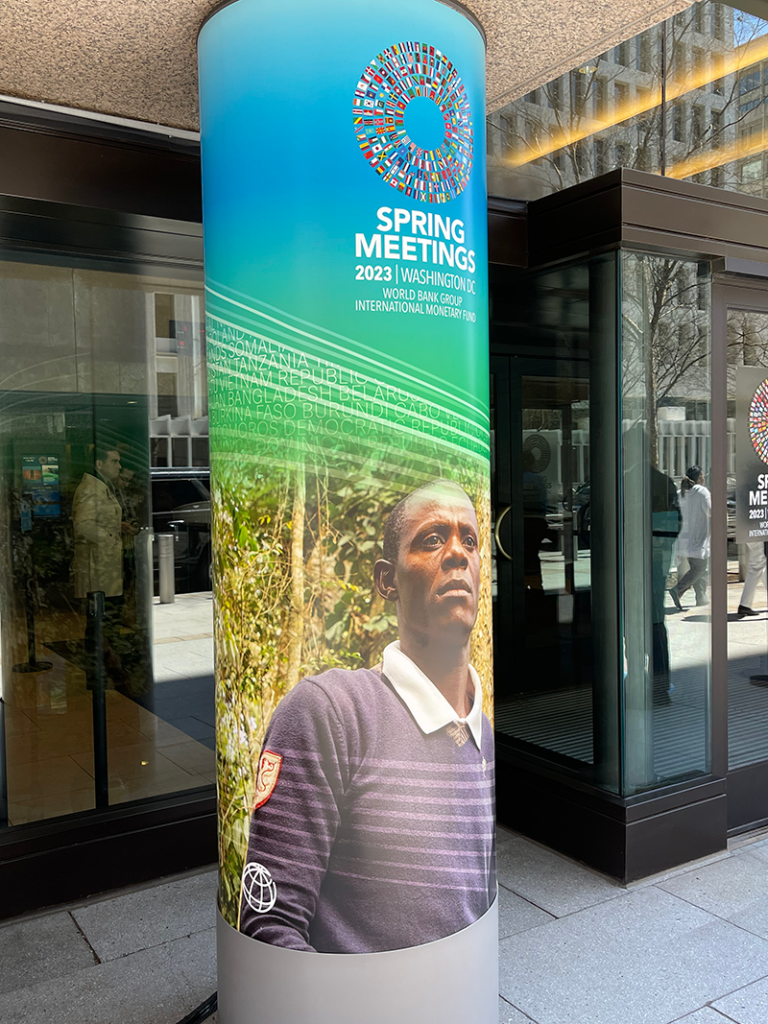
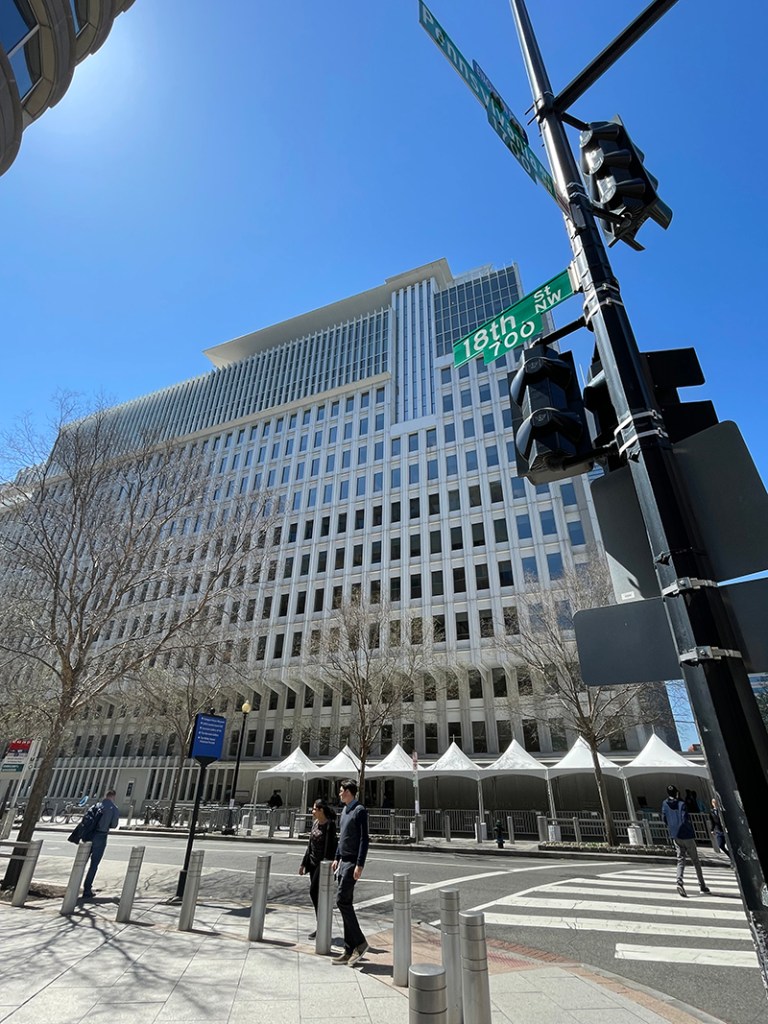
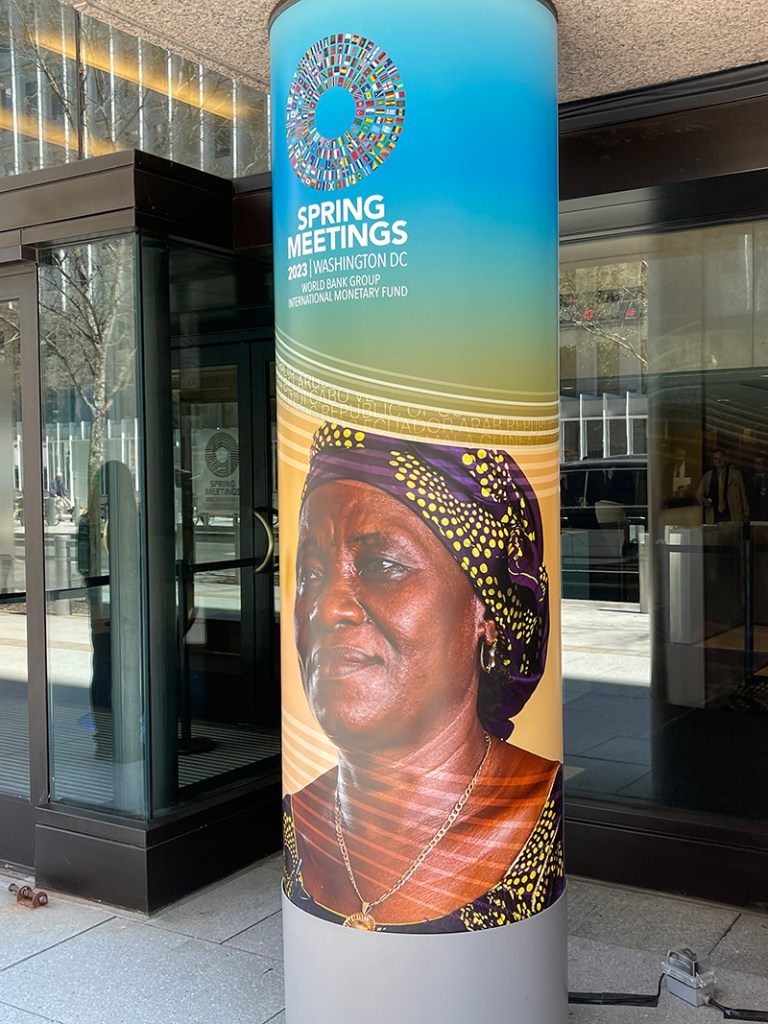
Representatives from 189 member countries will be convening in person for the first time in four years, a few blocks from the White House, for the 2023 World Bank/International Monetary Fund (IMF) Spring Meetings.
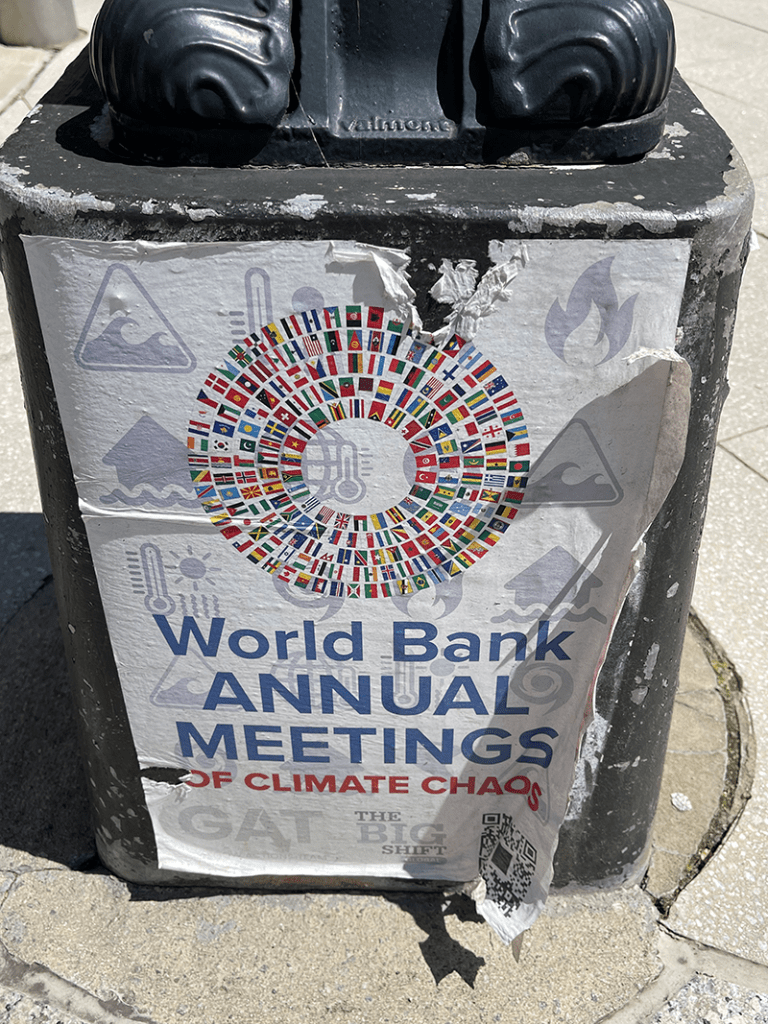
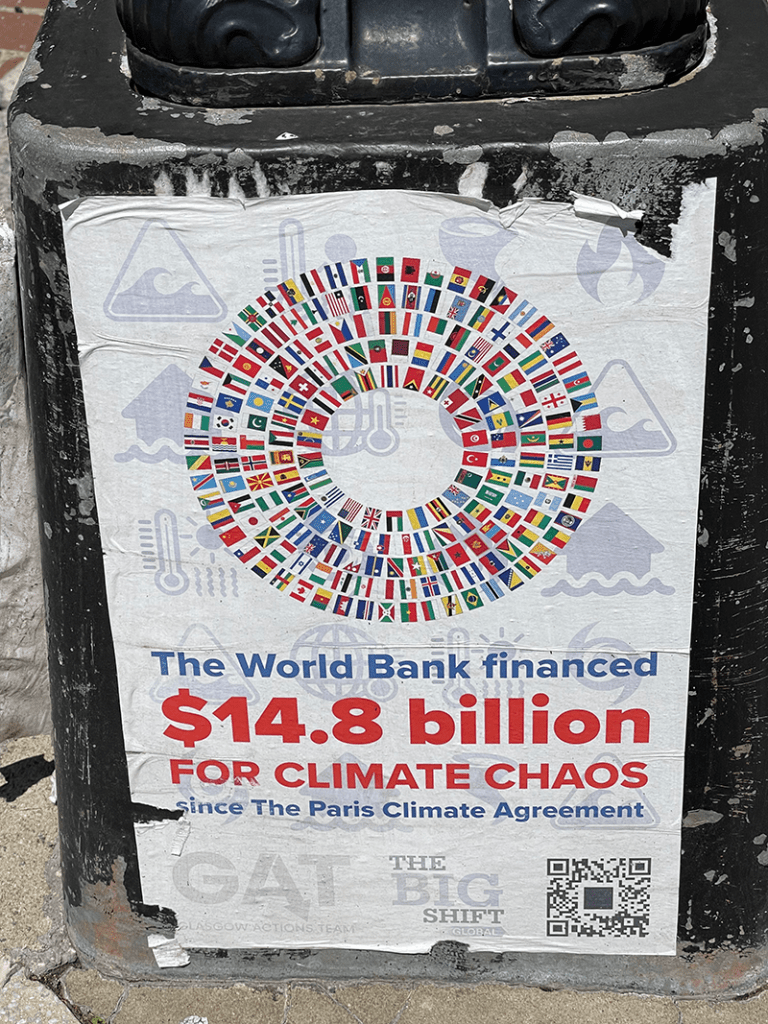
There are many who remain doubtful that the World Bank and IMF can rise to the challenge and meet expectations, after years of broken promises. “World Bank Annual Meetings of Climate Chaos,” reads one sign attached to to the lamp post in front of the The World Bank Group headquarters. “The World Bank financed $14.8 billion For Climate Chaos since the Paris Climate Agreement,” reads another.
ZME Science published an article by Fermin Koop on October 21, 2022, entitled “Broken promise: World Bank is pumping billions into fossil fuel projects despite climate pledge.”
Last month, the New York Times Editorial Board provided its weighty insights into the World Bank’s obligation to humanity: “It’s one of the great injustices of this era that countries contributing negligible amounts to global carbon emissions are now feeling the most harrowing impacts of climate change,” it began. “The World Bank and the donor countries that control it can do more to step up and tackle this generational challenge.” The OpEd challenged the fitness of the World Bank by calling on them, along with other multilateral lending institutions, to “figure out how to raise and leverage the massive amounts of capital” that will be needed “in the coming years to help countries adapt to and mitigate a changing climate.”
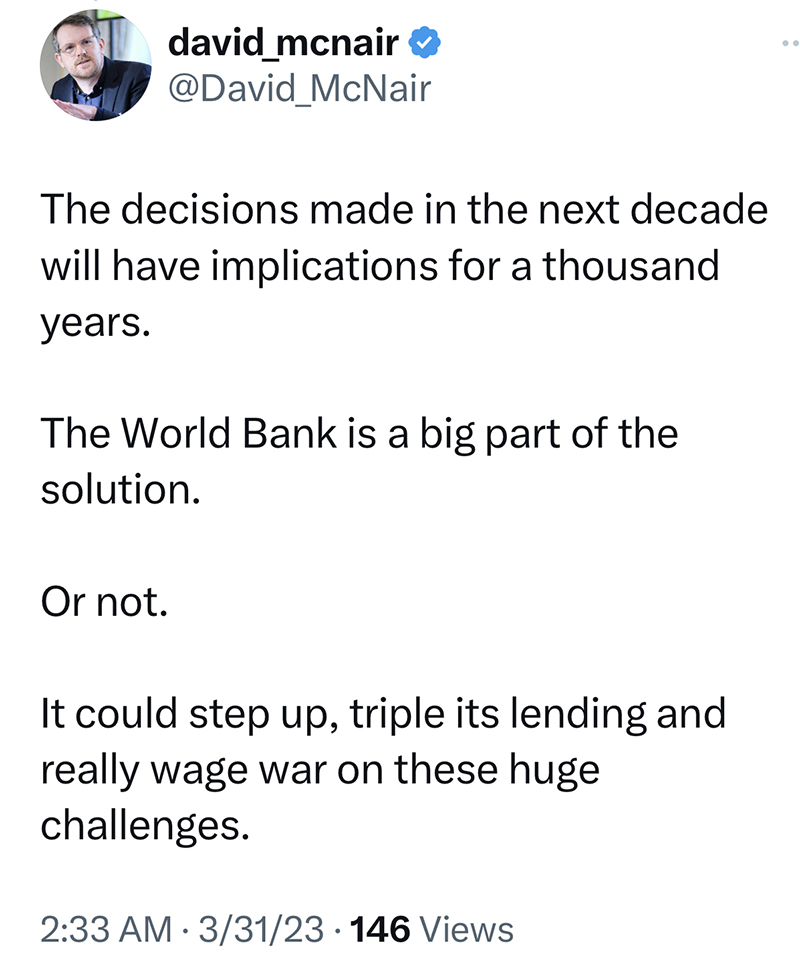
“To meet the challenges of climate change, inequality, and poverty, the @WorldBank must become the World’s Bank.”
David McNair, Executive Director one.org (Co-Founded by Bono); Founding Executive Board Member Africa Europe Foundation
In advance of the 2023 Spring Meetings, David McNair hosted an online discussion with a group of highly regarded experts: Liam Byrne MP, Amy Dodd, Mitch Comms, Daouda Sembene, Rob Floyd.
Some of the key facts the group outlined during their conversation, that the World Bank and IMF must address for the Spring Meetings to be successful:
- Extreme poverty has risen for the first time in the 21st Century.
- 200 million children across the globe are facing malnutrition.
- Despite COVID killing 17 million worldwide, there is still no pandemic readiness plan.
- $21 trillion in lost learning hitting children in low to middle income countries.
- Conflicts are spreading.
- Climate Change is destroying economies around the world.
- In 75 months (end of 2029) we’ll run out of the carbon budget that was established in order to stay within the limit of 1.5ºC.
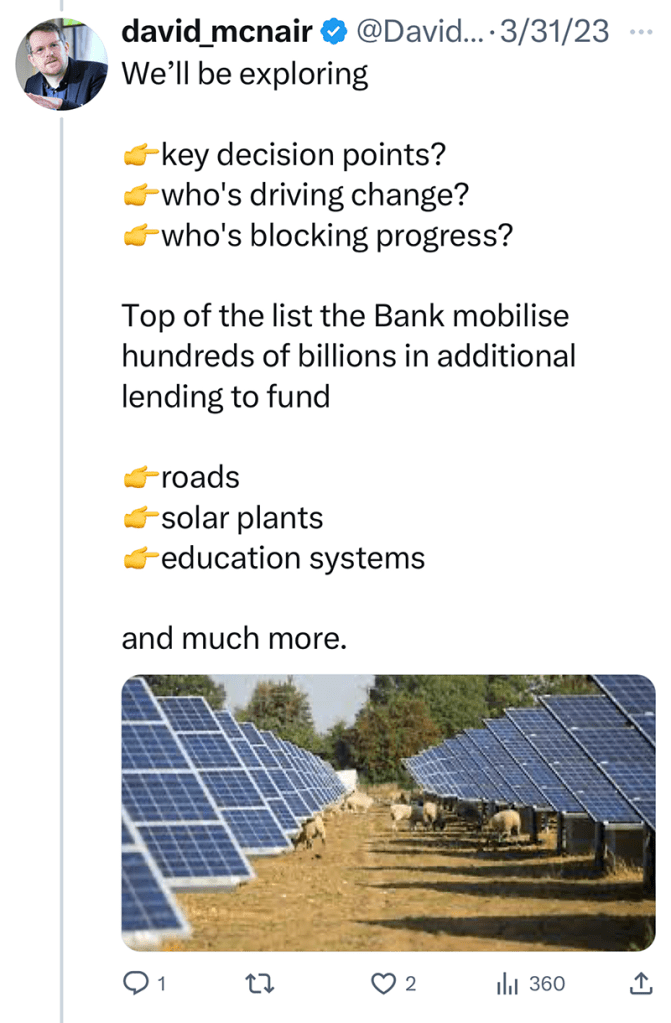
- World Bank must mobilize hundreds of billions of dollars in additional lending for roads, solar plants, education and more.
On the opening day of the 2023 Spring Meetings, World Bank President, David Malprass, and IMF Managing Director, Kristalina Georgieva, discussed the goals and obstacles that the world finance chiefs would be addressing in their week of “many meetings.” Obstacles that might impede progress and economic stability for many developing countries, but nonetheless, are goals that are still attainable in the view of Malpress and Georgieva.
There’s a “giant macro overlay of COVID, slow growth, rising interest rates, and Russia’s invasion of Ukraine, all of that conspiring in a way to give not enough money for any of the goals that we have for people in developing countries,” Malprass starkly stated before he continued with his favorable assessment of the World Bank’s purpose. He tempered his enthusiasm about the future by stating his concern for the lack of opportunities in developing countries. “There’s not a good avenue,” he said point blank. “There’s enough money in the world. There’s enough capital in the world to make it work, but my concern is it’s all absorbed into a small group, and it’s not working right now, and it takes some fundamental changes in order to make it work.”
Georgieva ended the discussion on a positive note. “I am very confident that solutions will be found. It is a matter of will, and then you find a way.”
She continued, “I always remember, in the context of this conversation, when we have a very steep mountain to climb, what Nelson Mandela once said: ‘Impossible until it is done.’”
Georgieva expressed her enthusiasm for a week of engaging with the membership, and the World Bank partners. “If we can imagine a world in which the tremendous capital, the wealth that is created, is put for the bigger public good, in which we open up opportunities for everyone to reach their full potential, in which we deal with the tremendous challenge of climate change, then we can say, ‘Mandela is right.’ All of these things that we discuss, that are so difficult, impossible until they are done.”
© Copyright 2023. ALL Rights Reserved.

 Climate Action Report