

Washington (CAR) Analysis | July 17, 2024 by Climate Journalist Noreen Wise; Image Credits: Noreen Wise
Weekly grocery shopping at Wegmans in Ashburn, Virginia is not the typical experience one usually encounters in the vast majority of suburban shopping centers across the United States.
Positioned beneath the behemoth Vantage Data Center towering on the slope above Dulles 28 shopping complex, Wegmans welcomes bustling shoppers through the double doors that face Vantage. The weekly throngs are unable to escape the surreal experience of living in the shadows of these giant, omnipotent structures.
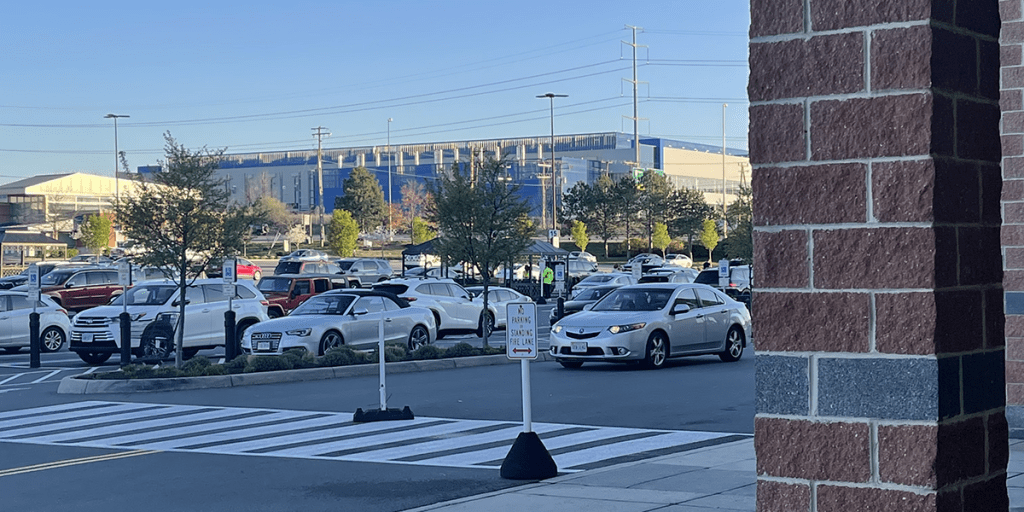
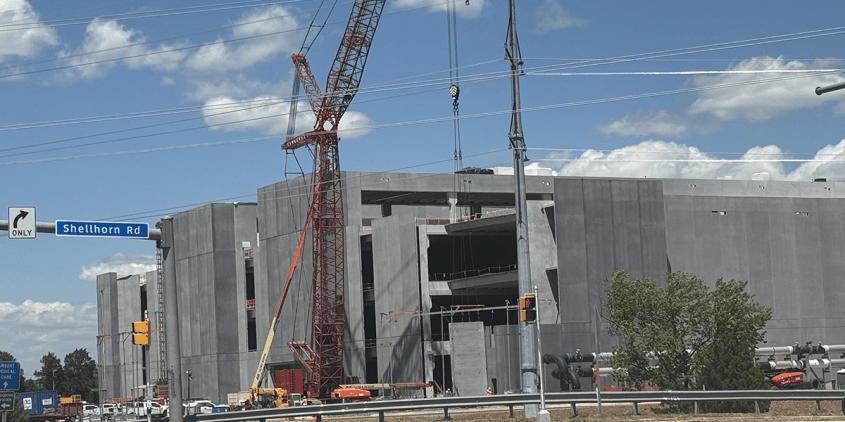
The Ashburn Wegmans is located in the heart of the data center capital of the world, along Waxpool Road, just one block from the mind-boggling intersection of Waxpool and Loudoun County Parkway. This eye-popping crossroads is flanked on all four corners with monstrously huge data center campuses. Ever-present, soaring cranes along this end of Loudoun County Parkway, aka Data Center Alley, conspicuously remind Loudoun residents that the recent explosion in data center growth isn’t going to recede any time soon, no matter how much more energy efficient the new chips become, nor how much more cabinet density the new chips can generate.
Living inside of, or near, the convergence of all the worlds’ internet and social media traffic, and in the heart of the global AI revolution, one can clearly see the negative environmental impact the data centers are having on what used to be considered the spectacularly beautiful Virginia Is For Lovers landscape, yet is now replaced with the previously unimaginable Virginia Is For AI datascape.

Commercial real estate professionals who work with data center operators, and lease colocation space to enterprises, are bullish on the Ashburn location, despite the many alternative data center markets that exist across the country and around the globe, including major cities like Dallas, Phoenix, and Chicago. The consistent explanation from these experts is one that we’re all familiar with: “Location, location, location.”
DATA CENTER ALLEY
Data centers located on prime real estate in Ashburn—the epicenter of the massive, sprawling cloud computing, as well as the entire world wide web, that’s intertwined with every aspect of our lives—pay an extraordinarily high price to be in Loudoun County. Amazon, Google, Meta, Microsoft, the US government have all staked their claims.
To properly absorb the epic size of this astonishing galaxy of endless colossal structures, one only has to fly into Dulles airport from a northern approach. The plane’s flight path lines up exactly with AWS, Compass, CyrusOne, Digital Realty, Equinix, NTT, Raging Wire, Vantage and many other data centers, as if these high intensity buildings are the High Intensity Runway Lights (HIRL) guiding pilots in for a landing. Otherwise, one can grab a bird’s eye view of Loudoun’s beguiling datascape by driving North on 28, and taking the Waxpool Road exit on the left. While rounding the elevated curved bridge exit ramp, drivers gaze upon the sea of mammoth concrete blocks that seem to stretch all the way to the Blue Ridge mountains far off in the distance.

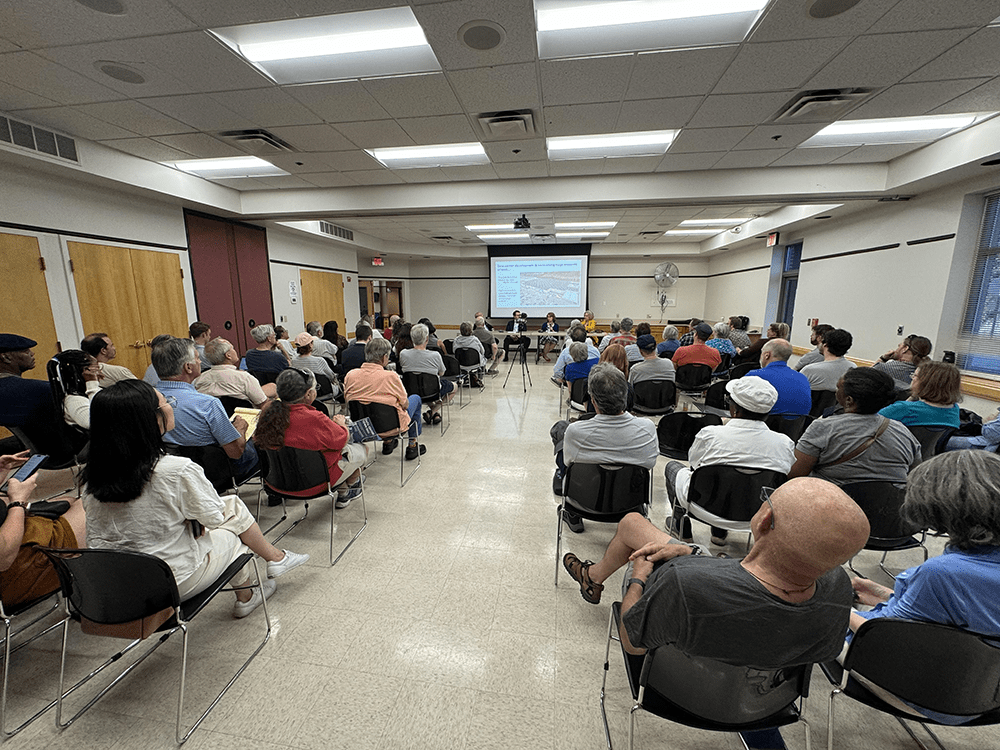
In a recent June 2024 Town Hall Meeting on data centers in the Algonkian District, one of Loudoun Counties nine districts, Supervisor Juli E. Briskman, Vice Chair of Loudoun County Board of Supervisors, outlined that from 2007 to the present (2024), the data center footprint in Loudoun County has grown from 5 million square feet to 31 million square feet. This explosive growth, for what had previously been considered a sleepy, rural county just a few decades earlier, (with 81% of it’s tax revenue coming from home owners), is rewarding the county with nearly $1 billion in annual business equipment tax revenue in 2024.
It’s estimated that 70% of the world’s internet flows through the data centers in Loudoun County and other parts of Northern Virginia on a daily basis.
According to the datacenterHawk website, Northern Virginia is ranked #1 in:
- Data center real estate supply
- Demand for data center real estate, measured by TTM absorption
- Hyperscale owned facilities, measured by operational power
- Colocation power commissioned within the market, measured in MW, which includes preleasing
- Speculative colocation power under construction within the market, measured in MW
- Speculative planned colocation power that hasn’t yet broken ground, measured in MW
WHY ASHBURN?
How did Ashburn and Northern Virginia become the data center capital of the world, anyway?
The short answer is connectivity, speed to market, and the ability to scale quickly. These core data center requirements not only entice companies to buy land and build data centers here, but they are also compelling reasons why consumers subscribe to a particular product or service offered by these companies. Amazon, Microsoft, Google, Meta, Netflix are ensuring reliability and an ultra fast connection, as well as rewarding investors and shareholders with consistent growth and substantial gains.
Imagine how aggravating daily life would be if our gmail and social media accounts were slow to respond, or if we experienced a consistent delay in connecting to our cloud services. How about the many enterprise services that are incorporated into our work lives that often seem to be plagued by high latency which slows down productivity? There appear to be a large number of small and medium-sized companies that can’t afford to pay the extra money to store their data in a primary market, and instead sign with data center space in secondary markets. One can easily feel the difference.
Ashburn, Virginia’s ultra low latency connection is attributed to several major irreproducible advantages:
- The 1960s Advanced Research Project Agency (ARPA), which was located in Arlington, Virginia, was established for the purpose of figuring out a way for research institutions, funded by the Pentagon, to communicate with universities. Before too long, ARPA developed the first ARPANET, an interconnected packet sharing network. Two decades later, ARPANET evolved into a very powerful connectivity artery that went on to become the internet.
- In mid-1996, AOL moved its headquarters from Tysons Corner in McLean, Virginia, to 22000 AOL Way in Dulles, which is off Waxpool Road, and across Waxpool from where Wegmans is located today. This was a very big deal for Loudoun County at the time. One might recall that in the 1990s, AOL was the most dominant brand on the web in the US, with millions of Americans subscribing to AOL’s dial-up internet service. Once AOL was up and running off Waxpool, it became a powerful fiber optic internet hub. Additionally, AOL’s presence in Loudoun County from 1996-2007 resulted in a tidal wave of top tech talent flowing into the area. Legend has it, that during these dot-com boom years, more than 3,000 AOL employees became millionaires, many of whom went on to become entrepreneurs in Northern Virginia after the dot-com bust.
- Loudoun County’s Executive Director of the Department of Economic Development, Buddy Rizer, has been with Loudoun County’s Department of Economic Development for 18 years. Early in Rizer’s tenure, he was faced with the daunting task of picking up the pieces following the 2008 housing market crash. At the time, the bulk of the County’s revenue, 81%, relied on the inflated housing market. New in his position, and with his back against the wall, Rizer had to figure a way out of the deep, dark hole the County found itself in. Rizer’s sole mission was to lure businesses to Loudoun County to help diversify the revenue streams. Rizer set his sights on the 3 empty warehouses on Loudoun County Parkway, and slowly began to lead the county into a new era. Rizer has been awarded the honor of Tech Titan by Washingtonian Magazine 7 times. He’s been named one of the top 50 most influential Virginians on 6 different occasions by Virginia Business Magazine, and has had the distinguished honor of being named one of the most influential business people in DC for 3 years in a row by Washington Business Journal. Rizer has brought more than $60 billion in new commercial investment to Loudoun County. In the aforementioned recent Town Hall Meeting for the Algonkian District of Loudoun County in June 2024, Rizer chuckled that 16 of his 18 years have been good, but the last 2 “not so much.” The Town Hall Meeting panelists were aspiring to educate the public on how we arrived at this critical moment of unstoppable data center growth without the ability to power all the buildings. This chasm has resulted in data center operators having to rely on highly pollutant diesel generators to supply uninterrupted power to their buildings. This solution negatively impacts the quality of life for many residents, hence one of the main reasons why the Algonkian District Supervisor Briskman and her panel were hosting a Town Hall Meeting on a hot June evening. Rizer stated that “We didn’t know when to say when,” so there are now challenges that the County has to find solutions for. “Revenue became very important to us,” (astonishingly, Rizer was able to grow the commercial tax revenue from 19% to 49% in 18 years, which very well might might be the largest increase of any county in the US in such a short period of time). “I am proud to represent Loudoun County. And I’m very proud to be part of this community for going on two decades now. And I want to be part of the solution as we go forward.”
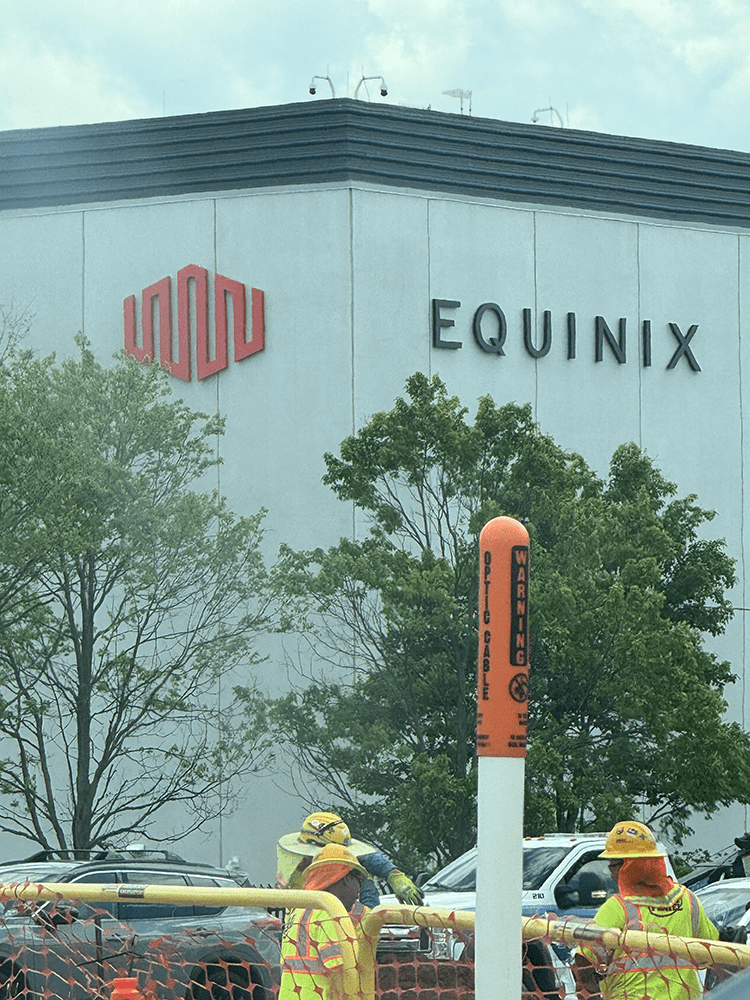
- According to the datacenterHawk podcast about carrier hotels, approximately 15 years ago, Equinix Data Centers built its DC2 carrier hotel in Ashburn, (less than 2 miles from 22000 AOL Way off Waxpool). The DC2 carrier hotel is an intricate ecosystem of numerous redundant fiber optic loops that connect the 200 providers located in the DC2 building (many data centers across the globe have as little as 4 or 5 providers). The closer a data center is to the carrier hotel, the faster the connection.

DATA CENTERS HAVE THREE LEGS
Data center buildings are concrete shells. Once built, there are three legs on which all the world’s data relies. Each leg has to be considered and negotiated which drives the pricing for the required capacity in a data center. The three data center legs are: fiber connectivity, power, and cooling.
- The robust, ultra low latency, fiber connectivity offered in Ashburn should now be well understood. So then how about power? Data Centers aren’t priced by square feet the way office buildings and homes are, but rather by kilowatt. According to the datacenterHawk podcast, the pricing scale used to be 250 kW per month or less, 250 KW-4 MW, and 4 MW and up. When cloud computing hyperscalers, such as Amazon Web Services (AWS) and Microsoft Azure, arrived, everything changed. There was suddenly demand for 30-60 MW even 90 MW. Data center buildings soon evolved into data center campuses, which required demand for that much more power, some as high as the previously unimaginable 100+ MW. This was soon followed by the recent explosion in AI that requires that many more megawatts of power and even larger data centers. The AI Revolution is dawning the advent of a massive data center park which may require as much as 1 GW on its own. In fact, much of the advanced AI functions require GPU-enabled data centers, which not all data center markets can accommodate. But, as you might imagine, the Northern Virginia market can. These particular data centers require exponentially more power than previous ones.
- According to the Piedmont Environmental Council (PEC), represented by Senior Land Use Field Representative Gem Bingol at the recent Algonkian District Town Hall Meeting, the current data center load in the state of Virginia is 3,200 MW/3.2GW. The proposed data center load in Virginia is expected to reach an astonishing 54,105 MW/54.1 GW. Additionally, there are already 4,000 diesel generators that have been approved for redundancy in Northern Virginia. Data center demand for fossil fuel powered electricity is expected to grow 152% in the next ten years.
- Power comes into a data center, and this generates heat that has to be cooled. Power in, heat out. Cool. This is the daily constant inside the 31 million square feet of data center space in Loudoun County. There’s two ways to cool the heat: air and water. Water-based cooling systems provide higher cooling efficiency than air, but air is more flexible and easier to scale. Currently, much of the 31 million square feet in Loudoun County is cooled by water, which has become another bone of contention between data center operators and the residents of Loudoun County. The massive volume of water per day that’s required to cool the data centers is pulled from the limited County water supply. Thus, both of these limited vital resources, power and water, create conflicts. This results in two powerful groups, both that feel equally entitled to the limited resources, pulling on a tight-rope.
POWER STRUGGLE & COMMUNITY ACTIVISM
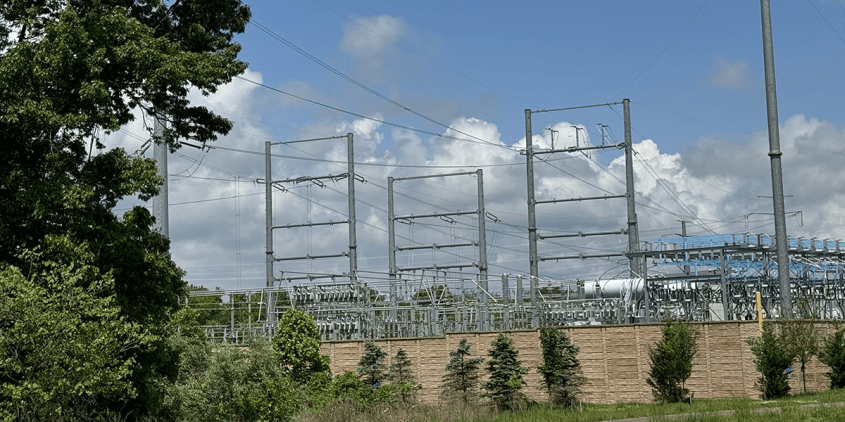
Fossil fuel Dominion Energy is required to power any structure that’s been built. Vice Chair Briskman reminded her Town Hall Meeting audience of this. Dominion has eminent domain and can confiscate privately owned land to build transmission lines to power the data centers in Northern Virginia. “They don’t want to, but they can.” Vice Chair Briskman articulated that the Loudoun County Board of Supervisors isn’t allowed to analyze power supply when considering rezoning applications, and they can’t ask the data center operators if Dominion has enough power to power their buildings. The Board has no way of holding the data centers accountable if it turns out that Dominion doesn’t have the required power.
Various Apps such as Ring and Nextdoor unite everyone in the county. During the recent extreme summer heat wave, there have been daily messages that pop up on phone screens in Ashburn and Sterling asking about power outages: “Power outage, anyone else lost power a minute ago?” …and “Power on, Does anyone else have power in Broadlands, I’m in Ashburn so can’t relate,” … “Power out in Sterling? Had anyone else in Sterling lost power? … and on and on. These daily messages remind tax payers that the power crisis in Loudoun County is real and will randomly plague residents for years to come.
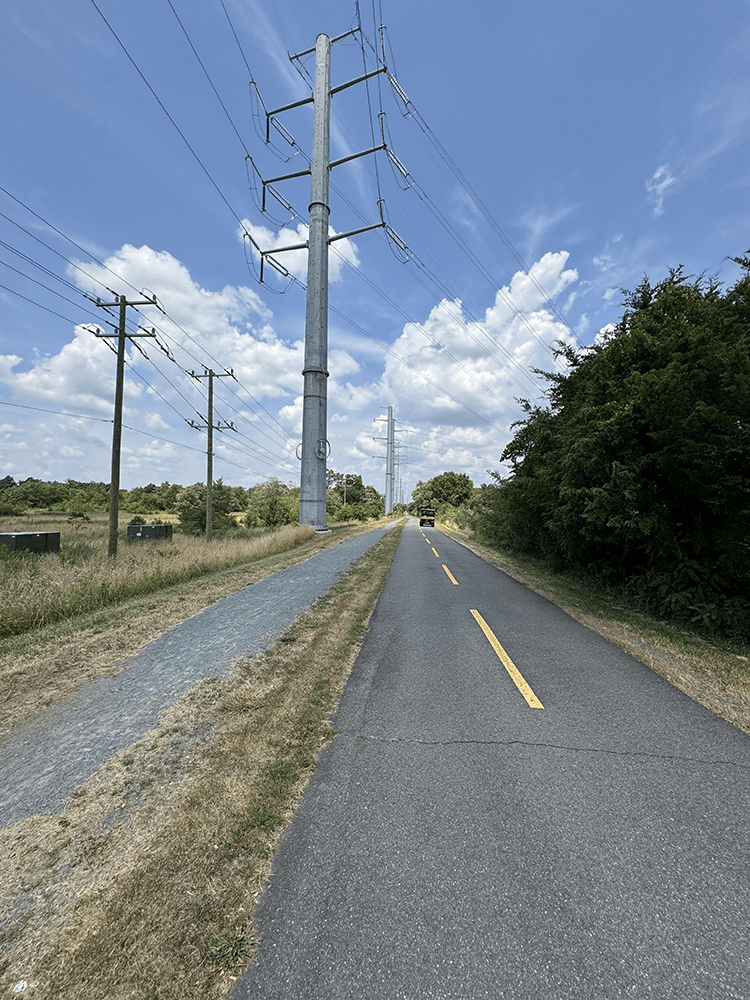
In 2017, Buddy Rizer first warned the County that “we have a power issue coming.” In 2020, Rizer reiterated his warning and provided a data driven analysis that outlined the best way to slow the current growth and manage future growth. At the time, the Board of Supervisors was unable to turn Rizer’s recommendations into reality, which has resulted in a “power issue” becoming a “power crisis” that has galvanized Loudoun County residents into action and activism.
It’s easy to envision why so many nature lovers and environmentalists made their homes in Loudoun County. The Potomac River creates the northeastern state boundary between Virginia and Maryland. Much of the protected land along the Potomac’s banks is parkland. One such treasure is Algonkian Regional Park, a favorite hangout for local residents and other Northern Virginians who have the opportunity to enjoy many miles of the beautiful Potomac Heritage Trail, replete with dense forests, rushing waterfalls, sprawling wetlands, and dense biodiverse meadows, all at their doorsteps. Local schools have crew teams that use the Potomac, and cross country teams that run along the wide trail through the vibrant forest. The majority of adults who live in Loudoun County are highly educated, and many are employed by numerous federal agencies in DC, as well as the Pentagon. Others still, are federal contractors making a name for themselves in their second careers after retiring from the military and various other high profile three letter federal agencies. And there’s a whole cadre of scientists, along with the previously mentioned tech titans.

Intelligent people ask questions and demand answers when their community becomes destabilized.
The past 6 months of 2024 have seen major public handwringing over the fallout of the unstoppable data center growth in the data center capital of the world. There have been a long string of public hearings, rallies, town hall meetings, bills introduced in the Virginia Legislature, news articles, calls to action, postcard writing, and social media posts.
MARCH 13, 2024 PUBLIC HEARING, BELMONT INNOVATION CAMPUS
One of the most heated 2024 data center public hearings was held on Wednesday March 13th in Leesburg, Virginia, the County seat. More than 50 people voiced their opinions about the Belmont Innovation Campus data center special exception application in which Vantage Date Centers had initially asked for 4.8 million square feet of data center use on its approved 112 acres (which would make it the largest data center campus ever built). This staggering size was reduced to 2.9 million square feet in its revised special exception application, which was what the public hearing was about.
One woman stood and referred to Ashburn as “Tattoo Man,” explaining that sure it’s wonderful to have one or two tattoos, maybe even three or four, but when a man’s entire body is completely covered in tattoos, it’s scary.
Natalie Pien, a resident of Loudoun County for 40 years, spoke from her position as a grandmother, despite being on the Board of several environmental/climate organizations in the DC/Southern Maryland/Northern Virginia (DMV) area. “I’m speaking on behalf of my most important role of grandmother. My grandchildren and all children deserve a livable future made possible by climate change mitigation. But, we’re heading in the wrong direction.” She informed the Loudoun County Board of Supervisors that the “Virginia Clean Economy Act law to mitigate climate change is doomed to failure by one industry, data centers.” That the industry is “inherently unsustainable.” Pien outlined the measures that Virginia political leaders undertook in 2024 to reign in the out of control data center growth. “The 2024 Session of the Virginia General Assembly saw over one dozen bills to regulate data centers.” Additionally, she exclaimed, “On December 11, 2023, the Virginia Joint Legislative Audit & Review Commission (JLARC) was authorized to conduct a comprehensive assessment of data center impacts.” Pien continued, that on a federal level, “A bill was introduced in Congress to study the environmental impacts of artificial intelligence, because AI can contribute to doubling the data center energy demand by 2026.” The passionate Pien concluded her allotted time with a plea for the Board of Supervisors to focus on the big picture rather than the individual applications. Don’t analyze each application “independently,” doing so “overlooks the cumulative impacts on the environment and energy.” Pien emphasized that “This approach contributed to Dominion Power’s inability to provide power to all approved data centers.” Their solution was to “allow Loudoun data centers to violate air permits and operate 24/7 on highly polluting diesel back-up generators,” and that is unacceptable.

A member of the Data Center Reform Coalition, Chris Tandy, came to the podium and stated his opposition to the “increase in fossil fuel based energy production cited as necessary to provide energy for continued data center development in Northern Virginia.” He underscored that “Dominion is forecasting the peak load will double by 2035 and the reason is data centers.” Tandy outlined Dominion’s plan for the accelerated growth in demand, stating it will use “natural gas and delayed coal plant retirements” as well as “drawing energy for outside our area.” Tandy identified “First Energy, which contributes energy to the PJM grid,” stating that they would be “delaying the retirement of two coal-fired power plants in West Virginia, the Fort Martin and Harrison coal plants,” that are now forecast “to stay online ’til 2035 and 2040 respectively, and they’re directly tied to resources and location for data centers in Northern Virginia.” Tandy concluded with, “We’re asking you to do what you can to control the growth of the data center industry in subsequent power load growth within our county, because Virginia meeting its greenhouse gas targets needs to be a priority.”
Senior Field Representative for PEC, Tia Earman, pummeled the Loudoun County Board of Supervisors with a series of jaw-dropping facts that hammered home the size of the monstrous structures. “Data centers in Northern Virginia operating today use 2800 MW, the equivalent of 700,000 homes. That’s more homes than in Prince William County and Loudoun combined.” … “Statewide, the data centers approved and awaiting construction will use 11,200 MW, 2.8 million homes. There’s only 3.6 million homes in Virginia y’all.” … “The applications filed awaiting approval would use an astonishing 58,400 MW, that’s 14.6 million homes, more homes than exist in New York City Washington DC, Los Angeles, and London, England combined.”
There were numerous Loudoun residents who stood and objected to the requirement that a huge swath of Western Loudoun farmland and forests be destroyed in order to install the massive transmission lines necessary to power Belmont Innovation Campus.

This landmark March 13, 2024, public hearing in Leesburg, Virginia lasted more than 6 hours, ending at 3:00 AM the morning of March 14th. Initially, the nine Supervisors voted 5-4 to deny Vantage the special exception for the supersized Belmont Innovation Campus. A few weeks later, Vantage returned with a 1.3 million square feet design. On April 10, 2024, by a vote of 6-3, the Loudoun County Board of Supervisors accepted this compromise.
Shortly thereafter, on Friday April 26, 2024, Google stunned activists in Northern Virginia with breaking news that it would be spending an additional $1 Billion on data center expansion in Loudoun and Prince William Counties. In a joint press conference, Google President and CEO Ruth Porat and Virginia Governor Glenn Youngkin, promoted the virtues of data centers. Porat lauded Google digital services that are integral to our daily routines: Gmail, Search, Maps, Docs, and Sheets. But, Porat sounded most enthusiastic about it’s AI future. “Together with our partners and community-led organizations, Google is committed to delivering targeted AI skilling and training so that Virginians, veterans, and millions of others can make the most of the opportunities of today and tomorrow.” Google emphasized that its investments in Virginia data centers are vital to the success of its cloud and AI businesses. Youngkin added, “Google’s ongoing investment in Virginia is a testament to our state’s skilled talent, robust infrastructure, and leadership in advancing the development and application of emerging technologies.”
AI AND OUR FUTURE
In a June 11, 2024 conversation between datacenterHawk Founder and President, David Liggitt, and SVP Head of Capital Markets and Investor Relations at Compass Data Centers, Johnathan Schildkraut, entitled “The Future of Data Centers: Innovations, Challenges, and AI-Driven Growth,” Schildkraft humbly stated, “AI has definitely surprised us. I think everybody in terms of the scale of demand.” Schildkraft eagerly shared details about Compass’ forever buildings. “The next generation will be much more power consuming, but much more powerful, and more power efficient.” Liggitt and Schildkraut talked about AI’s impact on data centers, predicting it would create a hockey stick in demand growth. Schildkraut warned, “This generative AI demand is a wave and it’s coming at us, and it’s ginormous.”
Wes Cummins, CEO of Applied Digital Data Centers, spelled out the urgency and aggressiveness of the present day generative AI demand in a March 2024 conversation with datacenterHawk’s David Liggitt. “Just on the AI side, just with generative AI workloads, there’s demand for 4-6 GW of data center capacity this year (2024).”
Bloomberg reported in March of 2024 that Amazon is expecting to spend $150 billion on data centers in the next 15 years, “giving the cloud computing giant the firepower to handle an expected explosion in demand for artificial intelligence applications and other digital services.” The article subheading read, “Spending spree is a show of force as the company looks to retain cloud computing edge over Microsoft and Google.”
SOLUTIONS TO THE POWER STRUGGLE
In one of the datacenterHawk podcasts, Liggitt revealed that his favorite song is Switchfoot’s “Dare You to Move.” After listening to it, I couldn’t help but feel that it captures the essence of how many Loudoun County residents feel about data center operators. The lyrics serve as a query, and a challenge to all the major players in the industry. “Welcome to the planet. Welcome to existence. Everyone’s here. Everyone’s here. Everybody’s watching you, now. Everybody waits for you, now. What happens next? What happens next? I dare you to move. I dare you to move. I dare you to lift yourself up off the floor. I dare you to move. I dare you to move.”… “Welcome to the fallout. Welcome to resistance. The tension is here. The tension is here, between who you are and who you could be, between how it is and how it should be. I dare you to move.”
Move into action. Immediate action. Northern Virginia residents dare you. What are you data center companies stating in your annual reports about sustainability and your carbon reduction targets? Do you want us to hang out on the SEC’s EDGAR and read for ourselves?
There are many data center executives, interviewed by Liggitt on his datacenterHawk podcasts, who speak about renewable energy and sustainability and the various strategies they have for tackling these important issues. Quickly putting words into action is now required.
During the June Algonkian Town Hall Meeting, Loudoun County’s Director of the Department of Planning and Zoning, Dan Galindo, explained that Virginia is a Dillon Rule state, and thus, counties aren’t able to pass data center moratoriums on their own. The County has to undertake studies and revise existing plans, which takes time. But in the short-term, “there are certain things that we can ask for and seek, that maybe we [can] get through conversation and commitments from an applicant that we cannot require under a zoning ordinance.”
Giant corporations such as Amazon, Google, and Microsoft, all competing for market share, and investing mega billions of dollars to build more data centers that have low and ultra low latency, and that will provide the best consumer services which will enable them to increase market share and their stock valuations, should have no problem spending a few hundred thousand, or even a few million, implementing the following essentials:
- All data centers must be completely white, roof and walls, to reflect the sun which lowers the heat inside by at least 10ºF, and helps decrease energy demand. White parking lots as well. The ice caps are shrinking quickly. We need as much white as conceivably possible. The DOE and EPA spell this out very clearly on their websites.
- Beautiful green living exterior walls (alongside the white exterior walls), similar to the one displayed next to the Kennedy Center’s Reach building, or on the exterior stone wall across from the 9/11 Museum in NYC, as well as the green living walls located downtown in major cities around the world. Green living walls will absorb much of the pollution being emitted by the generators, along with reducing the genie noise. Green walls absorb CO2 and provide food and shelter for pollinators and birds which is greatly needed following the massive deforestation and habitat loss that took place when building the sprawling data center campuses. And green living walls help mitigate the sweltering heat island effect, as well as restore beauty to the Northern Virginia landscape.
- Additionally, biodiverse, native meadows to restore soil health, and drawdown the carbon that was emitted from the soil during development. Meadows will help make up for the carbon that won’t be absorbed by the millions of trees that were leveled during development. Restored soil health will also improve water infiltration rates which will help replenish Loudoun County’s depleted water tables.
- Striving to achieve Platinum Level LEED certification.
- Solar panels on data center roofs may only provide a small fraction of the much needed energy, but it will provide some energy to some Loudoun County homes and that matters. If one data center campus can power one Loudoun HOA, then 200+ data center campuses can power 200+ HOAs, which is significant. Why is this a problem?
- Innovative wind trees, wind turbine walls, solar glass. High tech data centers should be incorporating as many high tech renewable energy solutions on their campuses as possible. It doesn’t matter that these innovative solutions can’t generate 1 GW of power. All that matters is that data center operators partner with these cutting edge clean energy innovators and bring in as many into their space as exist.
- Monitoring by NASA’s Orbiting Carbon Observatory (OCO-3) to document Loudoun County’s CO2 emissions so that the Board of Supervisors has an increased awareness of the data center industry’s forming a barrier for the County in reaching its CO2 emission reduction targets.
- Partner with the multiple carbon-free concrete startups to remove the massive amount of carbon emissions that exist in erecting massive concrete buildings. Forbes reported in May 2024, that we’re at the edge of the new age of carbon-free cement.
“Welcome to the fall out. Welcome to resistance. The tension is here. The tension is here. Everybody’s watching you, now. Everybody waits for you, now. What happens next? What happens next? I dare you to move.” —Switchfoot
© Copyright 2024. ALL Rights Reserved.


 Climate Action Report