

Washington (CAR) Analysis | November 15, 2022 by Climate Journalist Noreen Wise; Image Credit: AdobeStock; UPDATED February 12, 2024
Food waste in schools is epidemic. Elementary schools in particular have become food waste overachievers. From stuffed lunch bags and trays — which usually include fresh fruit, packaged applesauce, trail mix and similar snacks that health-conscious parents and school administrators endorse but can’t control — the daily mountain of nourishing food landing in school waste bins, headed for landfills, has reached crisis level.
On average, approximately 40 million tons of food are thrown into U.S. landfills each year. This sacrilege is worth an alarming $408 billion dollars. Meanwhile, 14 million U.S. households are food insecure, with many children going to bed hungry.
An open letter to school administrators, written by John Williamson, President of Food Rescue, highlighted that one billion food items from school trays are being “fed to landfills annually from American schools.”
According to a Penn State research study on school plate waste in the United States, an international audit conducted during the 2018-2019 school year, found that the amount of plate waste in the schools it surveyed in developed countries showed US students tossing a mind-boggling 27% to 53% of the nourishment on their plates, with fruits and vegetables representing the largest proportion, a staggering 50%. Chicken and eggs were at the opposite end of the spectrum, representing the least amount.
School Food Waste and the Climate Crisis
Food waste thrown in landfills creates methane which is 80 times times stronger than carbon dioxide over a 20 year period when it comes to warming the planet.
“Methane is 80 times more potent than carbon and it accounts for more than half, half of the warming we’re experiencing now. So cutting methane by at least 30% by 2030, can be our best chance to keep within reach of 1.5ºC.”
President Biden, COP27 Egypt
School food waste methane reduction is in the crosshairs of world leaders after 122 countries signed the Global Methane Pledge and now struggle to execute effective strategies for slashing global methane by 30 percent from the 2020 level by 2030.

USDA K-12 Food Waste Reduction Recommended Strategies
The U. S. Department of Agriculture has worked feverishly to create awareness about the pervasiveness of school food waste and the harm that it causes, as well as outlining multiple strategies for solving the problem.
- Offer-versus-serve (OVS) – Enabling students to decline food items they’re not interested in will reduce plate waste significantly. For example, the Penn State research study found that the majority of students they studied didn’t like baked beans and that most students leave all the baked beans on their plates. If given the opportunity to pass, the baked beans wouldn’t be tossed in the garbage bins.
- Market your meals – It’s important to boost excitement for school meals. The USDA offers fun suggestions such as “holding taste tests and recipe competitions or creating a student advisory committee to provide feedback on food acceptability and recipe names.”
- Extend lunch from 20-30 minutes – A poll conducted by NPR and Harvard School of Public Health uncovered that as many as 20% of the students surveyed in grades K-5 only had 15 minutes to eat lunch. Rushed meals result in children throwing out food that they otherwise would have eaten had they had more time. It’s believed that children given the time required to be well-nourished for the second half of the school day will do better academically. For example, the CDC conducted the Youth Behavior Risk Survey (YBRS) in 2019 and found that 42% of the students who received mostly As in their school work ate breakfast 7 days a week, while only 20% of the students who received mostly D/Fs ate breakfast each morning. The mostly B students were at 31% for eating breakfast, and mostly C students at 23%. Every single category in the survey showed a direct correlation between grades and dietary habits. Schools in Minnesota have found that having recess before lunch, resulted in students being more focused on what they were eating when they finally sat down to eat lunch, resulting in less waste.
- Create share tables – Following federal, state and local food and health safety guidelines, schools can setup a table in the cafeteria where students can drop-off unopened food and beverage items like milk cartons, granola bars, apple sauce, trail mix, unpeeled fruit, etc, which provides an extra portion for students who may still be hungry. The USDA offers implementation guidance.
- Saving food items – Providing children the opportunity to save a packaged food items to snack on later, not only keeps it from being thrown away, but also maintains a child’s nourishment level.

Once food waste is minimized, the only thing left will be for school lunch food scraps to be composted. Composting food scraps in schools is growing rapidly, and for many composting is part of the STEM curriculum. This in turn has a positive ripple effect on households. Children who compost in school often feel inspired to do the same at home and they help educate their parents on what steps to follow.
What’s Being Done at the Local Level
In the state of Virginia, Fairfax County’s Care To Share program is an excellent example of what types of food rescue programs schools can implement.
Care To Share was founded in 2019 by a mom who was working as a substitute teacher in Springfield, Virginia. One day, when she picked up her class from lunch in the cafeteria, she was shocked to see how much food was being thrown away by the students. Conflicted thoughts rushed through her mind: “Someone needs to do something about all of this food waste.” … “Why is no one addressing this?” She felt very frustrated and jumped into action. According to Fairfax County’s Care To Share ToolKit, this is how “Care To Share was born!”
And then the pandemic struck, and everything was put on hold.
Post pandemic, Alisa Brooks, Food Access Program Manager for Fairfax County Neighborhood and Community Services, brought Care To Share back to life. I was recently at an event in Fairfax where Alisa was explaining to the audience that there was so much interest in Care To Share, and she was fielding so many questions — there are more than 200 schools in Fairfax County — that together with the Fairfax Food Council, she created the Care to Share ToolKit.
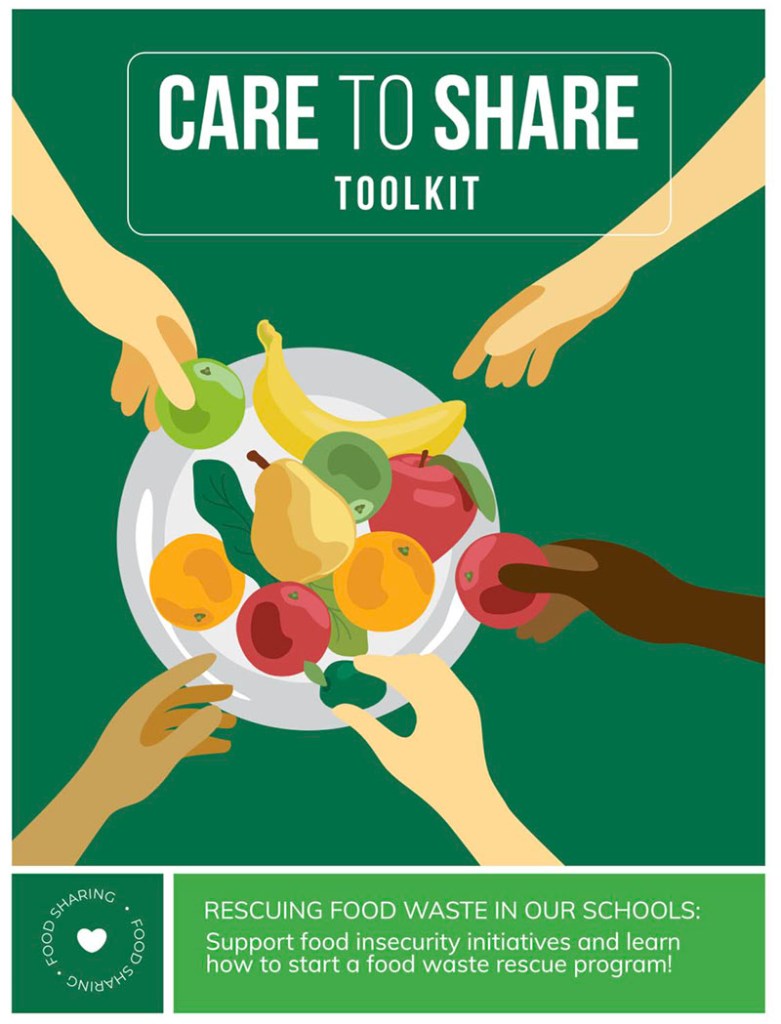
The Care To Share ToolKit is very simple and easy to follow which will make implementing the program similarly as simple and easy. Below are the essential tips highlighted in the ToolKit:
- RESEARCH before getting started. Investigate to find out what percent of students are food insecure and who the school community food insecurity champions are and whether the school has had a food sharing program in the past.
- EDUCATE the students on the importance of not throwing food away and why it’s meaningful to share the food they don’t want to eat.
- RECRUIT volunteers to help execute the Care To Share program every day that school’s in session. Students in older grades often need Service Hours to graduate and will likely be eager to participate and champion the program.
- PHYSICAL CONSIDERATIONS regarding where in the cafeteria the food will be collected and what type of bins the food will be placed in, as well as how to store perishable items, etc.
- LOGICAL CONSIDERATIONS regarding how the collected food will move from point of collection to storage and communicating the vital details about the movement amongst the volunteers.
Alisa Brooks is a recipient of the 2023 A. Heath Onthank Award for Merit, the most prestigious honor awarded by Fairfax County to its employees. Brooks was recognized for her “outstanding worth in advancing and improving public service in Fairfax County Government and Fairfax County Public Schools,” as was proudly noted on the Fairfax County Health Department’s website.
I asked Alisa to provide her current thoughts on the program. “With such staggering numbers regarding food waste, along with the dire situation our planet faces, paired with the millions that go to bed hungry, it’s imperative that we nourish our neighbors as much as possible. It’s a win-win situation; the more food we can get on families’ tables and out of the landfills, the better!”
© Copyright 2022, 2024. ALL Rights Reserved.

 Climate Action Report