

Washington (CAR) Analysis | April 8, 2024 by Climate Journalist Noreen Wise, and the segment on Supervisor James Walkinshaw edited by Andrea Lewis; Image Credit: AdobeStock
The growing global plastic crisis demands urgent attention and immediate action. Recent headlines have warned that invisible plastic particles pose a very serious health risk. “Microplastics Linked to Increased Risk of Heart Attack, Stroke, Study Finds,” was reported by Healthline in March of 2024. “Landmark study links microplastics to serious health problems,” informed Nature the same month.
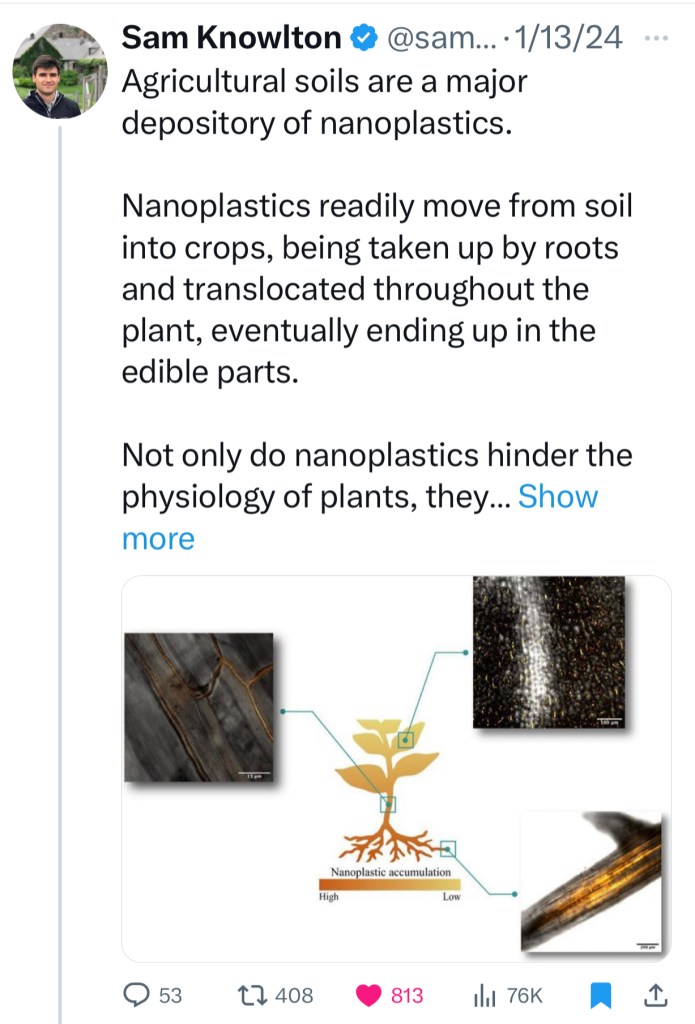
As if these shocking facts aren’t alarming enough to make us stop in our tracks and change our habits, Agronomy consultant Sam D. Knowlton alerted the public on X in January 2024 that “Nanoplastics readily move from soil into crops, being taken up by roots and translocated throughout the plant, eventually ending up in the edible parts.”
Plastics seem to be everywhere and in everything. A study commissioned by the World Wildlife Fund (WWF), and published in 2019, found that we consume the equivalent of a credit card worth of microplastics every single week. Gulping down 52 credit card-shaped stashes of microplastics a year, yet failing to open our eyes and do what needs to be done to turn this health threat around, is simply incomprehensible.
Single-use petroleum based plastics have been integrated into American culture, and our daily lives and habits, since the first name brands were introduced to the public in the mid 1900s. Products such as Saran Wrap, Ziploc bags, plastic milk and water bottles and jugs, plastic cutlery, plastic straws, have filled lunch-boxes, picnic baskets, and outdoor barbecue tables, and have rewarded us with many wonderful life experiences and memories. But there’s a dark side to these pleasurable conveniences that’s coming back to haunt us.
Petroleum plastics are indestructible and last for centuries. According to a study conducted by the University of California, Santa Barbara, 9.1 billion tons of plastic have been produced since the 1950s, 79 percent of which is stuffed into landfills and strewn across our oceans, littering more than 200,000 miles of coastlines around the world.
RELATED
EarthDay. Org summed up the extent of plastic contamination in our environment in its March 29, 2022 accounting of the plastic crisis, outlining that we Americans on average buy 50 billion plastic bottles of water each year. We toss 25 billion styrofoam coffee cups into landfills annually. Product packaging is what creates the greatest demand for petroleum plastic. Due to our lack of awareness, indifference, and/or personal irresponsibility, 14 million tons of plastic land in our oceans every year. Plastics in landfills break down into toxic fragments that contaminate the soil and runoff into nearby waterways.
Reusable plastic bags and drink containers have been around for more than two decades, yet, despite these simple, affordable, effective, healthy solutions, the majority of Americans persist in following a path of convenience no matter how deadly and damaging the consequences are.
The rapid rise in plastic production and consumption has seen a parallel unnerving escalation in global cancer rates. The Guardian reported in September 2023 that a recent study by BMJ Oncology found that cancer cases worldwide, in those under 50 years old, have soared 80 percent in the past three decades and is expected to climb an additional 21 percent by 2030. Simultaneously, National Geographic informed the public in June of 2019 that “half of all plastics ever manufactured have been made in the last 20 years.”
GLOBAL PLASTIC TREATY
Global leaders claim to be committed to ending plastic pollution. In March 2022, during the 5th Session of the UN Environment Assembly, a resolution was adopted requesting that the Executive Director of the United Nations Environmental Program (UNEP) convene an “Intergovernmental Negotiating Committee (INC) to develop ‘the instrument,’ that addresses the full life cycle of plastic, including its production, design, and disposal.”
The United Nations Environmental Assembly (UNEA) will be meeting for the fourth time during Earth Week 2024, April 23-29, in Ottawa, Canada. They’ve given their assurances that the Global Plastic Treaty will be signed by 175 countries at the end of 2024. The United States is one of the 175.

ASK WHAT YOU CAN DO
Clearly it’s time for all of us in the United States to dust-off and apply John F. Kennedy’s 1961 Inaugural Address challenge. Our individual actions are a significant part of the problem. We must ask ourselves what habits we can change. What reusable products we can buy. What food preferences we can alter. And what products we must refuse.
“And so, my fellow Americans, ask not what your country can do for you. Ask what you can for your country.”
John F. Kennedy, 1961 Inaugural Address
Many foreign countries have passed laws to help eliminate plastic pollution and its related health concerns. In 2022, Canada voted in the Single-use Plastics Prohibition Regulations, prohibiting the manufacture and import of plastic straws, stirers, cutlery, checkout bags, and foam food service ware. France legislated a similar ban on single-use plastic in 2022. As did the UK in 2023. But, in the United States, federal bans won’t be passed anytime soon. Thus, local community action will be what drives the much needed change.
PLASTIC EARTH DOCUMENTARY
In Fairfax, Virginia, a short drive from our nation’s capital, a group of concerned citizens gathered at Cinema Arts Theatres on March 18, 2024 to screen the acclaimed documentary Plastic Earth, followed by a panel discussion Q&A. The audience was eager to ask community leaders questions about combatting plastic pollution in Northern Virginia.
Supervisor James Walkinshaw of Fairfax County’s Braddock District stopped by Cinema Arts Theatres to provide opening remarks. Walkinshaw, the new Chairman of the county’s Environmental Committee and a native to Northern Virginia, passionately shared his experiences as a frequent volunteer for Lake Accotink Park cleanups. He explained how frustrating it was to repeatedly “trek through the mud and down precarious slopes to untangle tightly wrapped plastic bags from around bushes and trees.”
When voted in as Supervisor for his first term, Walkinshaw championed the Fairfax County plastic bag 5-cent tax and candidly revealed how many residents were angry about its implementation. The objective of the 5-cent tax was to motivate residents to change their behaviors in hopes of eradicating plastic waste from streams, roads, parks and other open spaces.

In light of this single-use plastic bag ordinance of January 2022, many residents chose reusable bags over being taxed. While others didn’t seem to mind paying 5-cents per bag. In 2022, the County received $2.4 million in revenue, and $2.2 million in 2023. These tax revenues fund Fairfax County’s zero waste program, Operation Stream Shield, and other programs that focus on reducing litter in the County. Nonprofit partner Clean Fairfax, that works hard to prevent and manage litter in Fairfax County, is excited about the 50 percent decline in the number of plastic bags they see. However, Walkinshaw confided, “Fairfax County residents are still buying and using roughly 40 million plastic bags annually.”
Fairfax County Director of Public Works and Environmental Services, Chris Herrington, was one of the post-screening panelists. He underscored the health risks associated with our “products of convenience,” explaining that there are “16,000 components in plastic, and that 1 in 4 of those is generally hazardous to human health and the environment, and only 20 percent of that is regulated by the government.” Herrington challenged the audience to think about what we’re doing when we use plastic, “We are literally killing ourselves in generating waste.” The Fairfax County Board of Supervisors has given Herrington the ambitious goal of 90 percent waste diversion by 2040. “That means radical behavior change on our part as well as some pretty massive new infrastructure solutions that we’ll have to come up with,” says Herrington.

Former Director of Climate at the World Bank Group, Stephanie Miller, was also a panelist following the Plastic Earth screening in Fairfax. Miller explained that toward the end of her career at World Bank Group, she began to wonder what more she could do to adopt a sustainable lifestyle for herself. It bothered her greatly that 50 percent of plastic waste is single-use plastic. She wrote a book, Zero Waste Living, the 80/20 Way: The Busy Person’s Guide to a Lighter Footprint, as well as founded Zero Waste in DC, devoting all of her time giving keynote presentations, and consulting with households and businesses about sustainability and minimizing waste. Miller recommended that we “take off our blinders about the single-use plastic we are bringing into our lives and start by focusing on one thing.” She explained that she did this in her own life by focusing on “the plastic water bottles I was buying every day, amounting to more than 600 bottles every year. I switched to a stainless steel reusable bottle, entirely eliminating the plastic water bottles in my life.”
Panelist Ken Cottrell is an Environmental Project Manager with 35 years of hazardous waste site cleanup experience. Cottrell addressed “legacy plastics” and reinforced Herrington’s remarks on the unregulated hazardous components in plastics, urging the audience to beware of toxic PFAS associated with legacy plastics and do our best to avoid these.
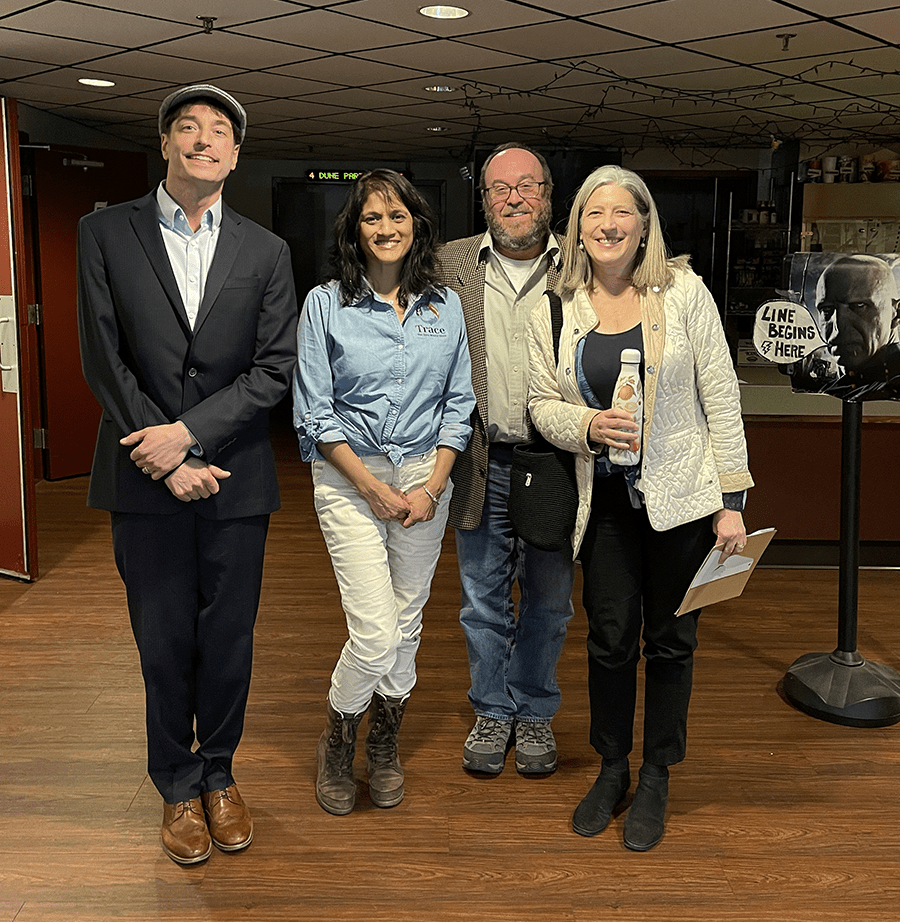
Marla Persaud enthusiastically shared that she is the owner of “Trace, the ONLY full-service Zero Waste Store in Northern Virginia.” She stressed that although Plastic Earth is a great film with excellent solutions, the most important word in the documentary is “REDUCE.” She challenged the audience to live differently. “It’s incumbent on all of us to not use the stuff in the first place.” She continued, that sure there are solutions, but many of these won’t be scaled up for years to come. “Bring your own coffee cup and stop adding to the trash heap.”
VIP guest, Jo Doumbia, stood to ask Persaud a question. She began by stating, “Mala is absolutely fantastic. She’s offering inconvenience. We have to carry our own containers!”
Plastic Earth is an award-winning documentary directed and produced by a concerned mom of four in Georgia, Janice Overbeck, who became so alarmed by the staggering amount of plastic pollution she stumbled upon while out on the ocean in late 2019, that she was motivated to research solutions and share the information through a documentary. I asked Overbeck what she felt was the most important takeaway from the film. “Emphasizing that exposure to plastics is toxic is the biggest message for me,” replied Overbeck.
“To solve the plastics crisis, we need action at all levels: a global treaty, state and city level plastic bans, and private business innovation. As for each of us, we can do our part by opening our eyes to the problem, making some changes in our own lives and then urging our elected officials and businesses we frequent to offer us more sustainable options.”
Stephanie Miller, Author of “Zero Waste Living, the 80/20 Way: The Busy Person’s Guide to a Lighter Footprint,” and founder of Zero Waste in DC

© Copyright 2024. ALL Rights Reserved.

 Climate Action Report