
Category: Climate Change

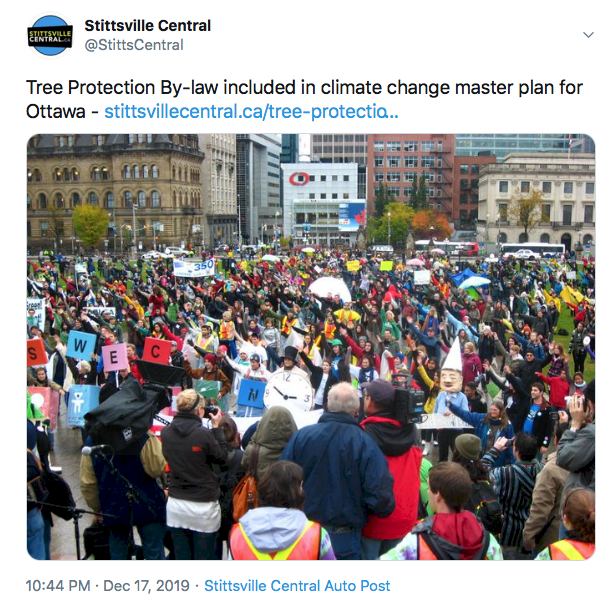
Ottawa’s Climate Change Master Plan

Washington (GGM) Analysis | May 19, 2020 NWHillReport-Pic by Noreen Wise With so much division and chaos in the United States right now, and the worrisome feeling that we’re falling behind on the substantial climate action progress we made in 2019, it’s inspiring to learn of a North American city that is all in on climate action forward motion right now, even during covid. Hurray! Ottawa, the Washington DC of Canada, ROCKS! Screen Shot 2020-05-19 at 6.36.30 PM Ottawa’s “Climate Action Master Plan” is impressive with it’s simple, straightforward mission statement, tangible targets, guiding principles and priority actions laid out in a concise one-pager. This is the ideal recipe for success. And success in carbon reduction was Ottawa’s prologue in creating their Master Plan: 14% cut in the city’s carbon emissions from 2012-2018, and a 36% reduction in carbon emissions by corporations during this time.
“The Climate Change Master Plan is the city’s overarching framework to reduce greenhouse gas (GHG) emissions and respond to the current and future effects of climate.” ~City of Ottawa
Ottawa’s Climate Action Master Plan Guiding Principles:
  • Responsibility – everyone in the community is responsible and needs to lower energy consumption and mitigate risks
  • Collaboration – all levels of government, all corporations, all citizens, utilities and stakeholders must work together to effect change and develop solutions
  • Municipal Leadership – the city will take the lead in fostering a joint partnership between corporations and the community
  • Coordination – the long term agenda must be strategic and harmonized
  • Equity and Inclusion – all decision-making processes must be equitable and inclusive
Screen Shot 2020-05-19 at 6.54.37 PM Thank you, Ottawa! We’ll just follow your example.🌳

© Copyright 2018 – 2020. ALL Rights Reserved.

This image has an empty alt attribute; its file name is esgmark75.jpg

This image has an empty alt attribute; its file name is gallantarcher_3d_socialmedia.jpg

Renewable Energy Continues to Surpass Coal in US

Washington (GGM) Analysis | May 15, 2020
NWHillReport-Pic by Noreen Wise

It was a year ago, last spring, that we learned renewable energy usage exceeded coal usage during the month of April 2019 for the very first time ever. At one point that month, the gain was 9 straight days in a row, another first, and 38 days total for 2019 Newsweek recently reported.

Screen Shot 2020-05-15 at 6.06.27 PM

It’s therefore exhilarating to be one giant step further along the road to a complete renewable transition.  In 2020, every single day for the entire month of April, renewables exceeded coal, for a total run of 40 straight days of renewables crushing coal. The price of coal increased during this same time period, while the cost of renewables decreased, which appears to be a factor in the favorable outcome for renewable energy.

BrightSide-SquareNEWER-400
Daily conversation focused on how to turn a negative into a positive and land on the bright side. A daily emotional 7 minute vitamin to boost your spirits. Podcast Host, Noreen Wise. Climate Friday! What is wet-bulb? Is it scary?

It’s a particularly significant success in light of the fact of how forcefully our president has been trying to sway public opinion to back coal, as one coal company after the next declares bankruptcy. It appears the American public is slowly adapting to the reality that the elimination of fossil fuels is inevitable, so they might as well transition sooner rather than later and take advantage of all the discounts and rebates before they disappear. 🌞

Screen Shot 2020-05-15 at 6.11.01 PM

© Copyright 2018 – 2020. ALL Rights Reserved.
GallantLogoNWST-75

No More Natural Gas| Berkeley, CA

Washington (GGM) Analysis | May 13, 2020
NWHillReport-Pic by Noreen Wise

It’s always the small things that make the difference in big transitional changes. So too with our transformation into renewable energy. If every household committed to replacing gas stoves and gas grills with electric in 2020, we’d be well on our way to converting our homes to solar and wind. Bloomberg Green’s recent article about this new trend highlights the pros and cons.

Realistically though, it’s all about taking the first step. We need to eliminate all fossil fuel usage including appliances. If we know that the elimination of fossil fuels is inevitable, (does anyone doubt that it is), then we should all immediately begin to replace easy to replace appliances. This is how progress is made. One step at a time.

Screen Shot 2020-05-13 at 6.13.21 PM

Last summer, Berkeley, California  became the first city in the United States to ban natural gas in new homes. The law was passed unanimously and went into effect January 1, 2020. Interestingly, Berkeley was also the first city in the United States to ban smoking in restaurants and public places back in 1977. There’s a saying in California: As goes Berkley, so goes California. Let’s be on the look out for more California cities to continue with this trend, creating the much needed momentum.

BrightSide-SquareNEWER-400
Daily conversation focused on how to turn a negative into a positive and land on the bright side. A daily emotional 7 minute vitamin to boost your spirits. Podcast Host, Noreen Wise. Today’s Episode: What to do when the devil walks into your life.

Berkley of the East, Takoma Park, Maryland just passed a climate agenda in which they plan to become the first city in the United States to ban all fossil fuels. According to the Washington Post, the town’s 2020 Climate Emergency Response Act, was written in an effort to guide local officials in policy making in the upcoming years.

As always, the changing of the tides comes when one person, one town is willing to step boldly in the right direction. Thank you, Berkeley, California. May your small step with climate action be as successful as the revolution you kicked off when you banned smoking in 1977. Think of how many lives Berkeley saved. Cheers to the Butterfly Effect.🦋

Screen Shot 2020-05-13 at 6.12.10 PM

© Copyright 2018 – 2020. ALL Rights Reserved.
This image has an empty alt attribute; its file name is esgmark75.jpg

This image has an empty alt attribute; its file name is gallantarcher_3d_socialmedia.jpg

Change One Thing | Climate

Washington (GGM) Analysis | May 7, 2020
NWHillReport-Pic by Noreen Wise

There’s an amazing campaign underway in Europe, #Change1Thing. Brilliant. And even though we each need to change many of our daily habits to save the planet and our futures, if we begin with one small change, we’ll soon find how contagious it is.

My #change1thing is window boxes and adding as many flowers and as much nature around my home as possible. A friend suggested dropping wildflower seeds along fence lines and forest trails. Seeds are fantastic. They can easily be ordered online. They’re inexpensive and lightweight and a positive mood booster once they blossom.

screen-shot-2020-05-07-at-5.10.41-pm.png

Nature curbs atmospheric carbon levels by storing carbon. Our oceans are stuffed with carbon and overheating, so we need more nature to store the increased carbon emissions. Flowers and shrubs grow faster than trees, thus we can quickly raise the amount of carbon storage in the near term, by adding many more layers of nature around our homes and yards. Window boxes also increase property values. Eco Architecture is springing up across Europe, creating amazing nature wallscapes of live green up and down office towers.

BrightSide-SquareNEWER-400
Daily conversation focused on how we can turn a negative into a positive and land on the bright side. A daily emotional vitamin that will boost your spirit. Podcast Host, Noreen Wise. Today’s conversation, can one small act of kindness change the trajectory of someone’s life?

Additionally, nature boosts serotonin, the feel good hormone that improves mental health. And flowers are pollinators which promotes biodiversity, resulting in a much healthier environment.

Let’s all jump in with #change1thing. Action is a healthy feel good during such a calamitous pandemic. If we can learn valuable lessons from covid, and apply to climate, we’ll be miles ahead and on the road to recovery and a brighter tomorrow.

Thank you One One World – Instagram! Change1Thing ✅

© Copyright 2018 – 2020. ALL Rights Reserved.
GallantLogoNWST-75

Ocean Waves Harnessed for Renewable Energy | Wave Power

Washington (GGM) Analysis | May 4, 2020
NWHillReport-Pic by Noreen Wise

There was a glimmer of hope on Friday when Bloomberg News reported that fossil fuels have been hammered by covid-19 and are experiencing a projected 9% decline in 2020, while renewable energies are surging ahead, tracking at an increase of 1% this year, despite the economy being rocked by 30 million layoffs. Covid-19 has resulted in quick transformations in key areas of our lives — education and work from home to name two. Let’s not stop there. Covid is the ideal opportunity to take advantage of the change momentum and leap into renewable energy solutions for municipalities, homes and businesses.

In addition to wind and solar, wave energy is an emerging renewable solution. Wave energy has proven to be an excellent way to flip around the disadvantages of rising sea levels and the devastating impact on coastal communities, and harness this powerful force by turning it into a renewable alternative. According to Smart Energy International, China just launched the largest wind energy turbine in the world in Wuhan, during covid-19 no less.

Screen Shot 2020-05-04 at 6.05.26 PM.png

In the United States, Oregon is out in front on wave energy. According to Oregon Public broadcasting, a Portland industrial company, Vigor, created the very first “wave energy convertor, called the OE35 buoy” that will be tested in Kanehoe Bay, Hawaii for 12 months. Vigor has been involved in wave energy for a decade, so let’s keep our eyes on them in the upcoming months.

The American coastline is massive, it’s one of our greatest natural resources. In fact, it’s estimated that 64% of America’s energy can be powered by ocean waves.


Screen Shot 2020-05-04 at 6.06.22 PM.png

A quick search on Twitter indicates there isn’t much conversation about the exciting potential of wave power. But if China is jumping in this boldly and aggressively, America should definitely take note. Besides, there’s something comforting about turning a negative into a positive, and harnessing these big giant blue waves. Waves that have been crushing us ever since Hurricane Katrina destroyed New Orleans, and use their powerful force to destroy carbon instead, dramatically curbing global warming and calming the raging forces of climate change. 🌊

BrightSide-SquareNEWER-400

© Copyright 2018 – 2020. ALL Rights Reserved.

GallantLogoNWST-75

Home Composting Essential for Climate| Especially During Covid

Washington (GGM) Analysis | May 1, 2020
NWHillReport-Pic by Noreen Wise

It was an exciting excursion to the grocery store today to see as many as 90-95% of shoppers wearing a facial covering and gloves. It spoke volumes. The grocery store itself was doing an amazing job of keeping the public safe:

  • huge roll of paper towels on top of carts with spray cleaner (yes, I washed my cart down)
  • repeated overhead announcements that there’s a global pandemic and that covid19 requires social distancing, “please stay six feet apart”
  • the self-checkout area of two parallel rows of five cash registers on each side, was spaced appropriately so that only four of the ten registers were in use
  • everyone waiting in line was six feet apart

BrightSide-SquareNEWER-400
Daily conversation focused on how we can turn a negative into a positive and land on the bright side. A daily emotional vitamin that will boost your spirit. PodcastHost, Noreen Wise.

It gave me peace of mind to see with my own eyes that the vast majority of us in Northern Virginia are paying attention and following directions. That we care about the well-being of others. We respect the advice of the experts: Governor Andrew Cuomo, Dr. Fauci, our own Governor Northam, and many others. And that we understand that as soon as we’re all onboard with these types of daily habits — facial coverings, gloves, keep our distance, respect of others, follow advice — we’ll be able to phase back into society and slowly restart the economy one step at a time. We’re showing by our actions that we’re ready to do what it takes.

Look how quickly we accomplished this. Less than six weeks. Commendable.

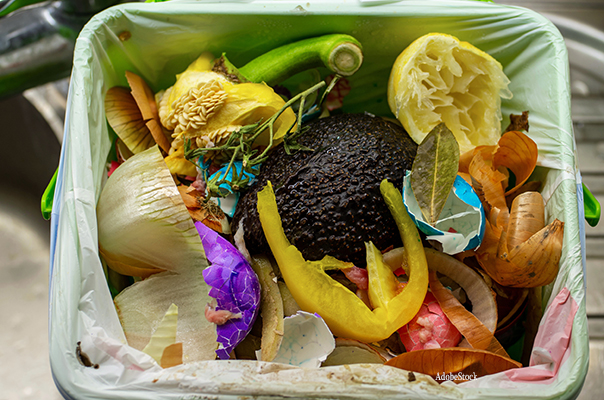
Let’s do the exact same for climate, nailing one component at a time. Home composting is ultra simple. Food scraps that we normally throw into the sink composter, get thrown into a covered plastic kitchen bin, that can be added to a larger yard or garage bin weekly or daily depending on how many are in our household.

Natural food waste recycling concept
See how easy this is?


It’s advised that once compost is tossed into the larger bin, that the heap should be turned once a week, and water added to speed up decomposition. It will take approximately one month for it to be ready to till into our yard and or forest soil. The breakdown of the larger garage or outdoor bin, should be one third green scraps — food scraps that include all foods, tea bags, coffee grounds and filter, egg shells, lint and grass trimmings — and two thirds brown scraps, made of leaves, twigs, shredded newspaper, and hay. The green scraps contain nitrogen, and the brown contain carbon. The ratio of one third green to two thirds brown is important.


Screen Shot 2020-05-01 at 5.13.22 PM.png

According to Home Composting Made Easy, as much as thirty-five percent of our household waste can be reduced if we home compost. Waste management has been a thorny challenge during covid stay-at-home, so a reduction in the amount of waste to pick up will improve the well-being of these essential workers, conquering two challenges at the same time.

Screen Shot 2020-05-01 at 5.14.03 PM.png

When home compost is added to the soil, the increase in nutrients enables the soil to sink more carbon. Further, the fungus and good bacteria found in the compost protects trees from deadly nematodes as well as other plants which increases the amount of carbon each can store. The compost nutrients nourish nature, enabling it to grow taller and fuller and in so doing, store that much more carbon.

Okay, let’s go! Can we all nail this in six weeks the way we accomplished covid facial coverings? Of course we can. I’ve been home composting since October 2019, and find that it’s a significant improvement in household waste management. I love how my kitchen garbage is so lean. I only need to empty once a month. Nothing stinky to worry about. I either recycle or compost, so the only garbage is plastic bag packaging, the kind that frozen vegetables are packed in. Good luck!🌱

© Copyright 2018 – 2020. ALL Rights Reserved.
GallantLogoNWST-75

The Golden Rule & Covid-19 | Recycling and Waste Management

Washington (GGM) Analysis | April 27, 2020
NWHillReport-Pic by Noreen Wise

“Do unto others as you want them to do to you.” ~ The Golden Rule

It’s exciting to see that recycling has been deemed an essential service during covid-19, but keeping these dedicated waste management employees safe during the global pandemic is equally as important.

With everyone stuck at home, there’s now more home garbage than ever before. Further, the vast majority of us are ordering the bulk of our purchases online, and having it delivered, so there’s likely a mountain of recyclable cardboard boxes associated with each household. And how about glass bottles from our favorite alcoholic beverages? Many manufacturers rely on these particular recyclables to produces their products. Cardboard and glass are two of the more essential components of the supply chain for recyclable manufacturing.

So, how is recycling being handled during covid-19? There seems to be conflicting accounts depending on the state and local municipality.

BrightSide-SquareNEWER-400
Daily conversation focused on how we can turn a negative into a positive and land on the bright side. A daily emotional vitamin that will boost your spirit. PodcastHost, Noreen Wise.

Here’s what we know according to The Recycling Partnership:

  • even though deemed essential, many communities are suspending curbside recycling pickup so please check with your town’s waste management website
  • if your locality has drop off recycling, please try and take advantage of this, while maintaining the safe protocols of a facial covering and gloves, manufacturers are desperate for these materials
  • cities will have much tighter budgets in the new fiscal year beginning July 1, 2020, many towns are discussing cutting back on curbside recycling pickup, so we have to make plans each week to drop off recyclables at drop off centers
  • states and municipalities are still trying to work out the best way to handle plastic PPE and recycling, hard plastic can be recycled, but it can be dangerous, (more information below)
  • Wipe garbage bin handles down before rolling to curb, and wear gloves when pushing the bin to curb

Screen Shot 2020-04-27 at 5.24.46 PM.png

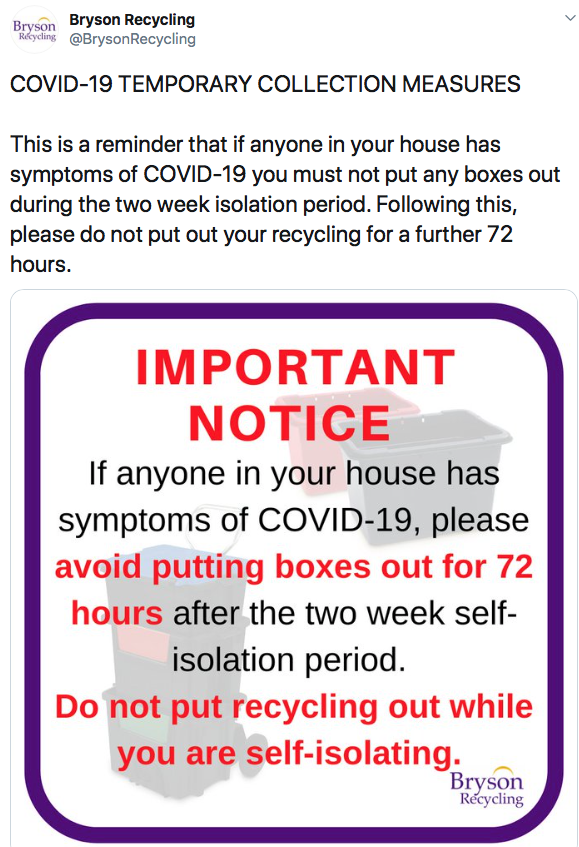
Additionally, there are specific rules regarding how to handle waste and recycling if anyone in the household has tested positive for covid-19.

  • No garbage brought to the curb during the 14 day quarantine period
  • add an additional 72 hours to the 14 days for recycling

Screen Shot 2020-04-27 at 5.25.10 PM.png

Our individual actions are life and death for many in our communities. It’s very important that we follow the guidelines to keep everyone safe. The golden rule has never meant more than it does right now. Do unto others as you want them to do unto you. ♻️

© Copyright 2018 – 2020. ALL Rights Reserved.
GallantLogoNWST-75

Time to Plant Climate Gardens While We’re Stuck at Home

Washington (GGM) Analysis | March 14, 2020
NWHillReport-Pic by Noreen Wise

Backyard gardens are one of the easiest most inspiring ways to lower our carbon footprint. Adding multiple layers beneath trees and along fences, lining the front of homes. Shrubs, flowers, vines, ground cover. Ivy and creepers up and down walls, around mailboxes and lamplights. International cities like London and Paris have perfected this.

The best part about zeroing in on a giant burst of nature as the solution, is that it works immediately, especially if we all collectively execute ASAP, during these next few weeks while we’re stuck at home hoping tp stay clear of the coronavirus pandemic.

Imagine the positive impact.

HillReport3-13-2020.jpg

In the nick of time, no less. We’re down to only nine years to save humanity from climatocalypse. So, the silver lining of being thrown into our current heart-wrenching calamity, with unexpected at-home time on our hands, is that we can pause and focus on the long term, and alter our destiny by conquering what otherwise would most likely be an improbable collective gardening effort.

Live in an apartment or condo? Balcony, patio and rooftop gardens or plantings on every available flat surface is a life-and-planet-saving difference. With a success rate as significant as this will be, at a minimal cost, we can all jump in first thing in the morning.

HillReport3-14-2020d.jpg

Screen Shot 2020-03-14 at 12.05.28 AM.png

Bringing back nature, will not only be a giant leap forward in our progress at lowering our atmospheric carbon level back down to 350 PPM, but has multiple other valuable benefits.

Nature improves mental health, not only an emotional positive boost, but a sensory one as well. Sunlight provides the much needed daily dose of vitamin D that will keep our outlook positive and optimistic. Additionally, nature’s scent has an array of therapeutic properties. Some species are calming and supportive, while others keep us alert and energized. There’s also the tangible, yet little understood, sentient characteristics of nature that indicate plants and trees can problem solve, even connect with other plants and animals, as well as communicate with each other, and some believe communicate with humans, in addition to nurturing humans,  .

Screen Shot 2020-03-14 at 12.06.50 AM.png

Considering how many alarming societal threats we face — climate, suicides, drug addiction, physical and mental health — the fact that nature can aid in improving every single one of these, is a very compelling reason to quickly sow our climate gardens during this unexpected period of being stuck at home (at least it’s spring, the planting season). In fact, there’s no better way to keep our minds off this extended emergency, than to dig into a powerful solution that will not only bring back nature, but will keep us calm in a crisis.

Once nature is back, the wildlife that goes along with it will also return. Our planet will be healthy again, which will make humankind that much healthier too. It all begins right now, during these mandated weeks of social distancing.

Let’s GO!

© Copyright 2018 – 2020. ALL Rights Reserved.
GallantLogoNWST-75

Powerful Impact of Meadows on Carbon Sink

Washington (GGM) Analysis | February 24, 2020 by Noreen Wise

Thousands of innovators across the globe are aggressively working to manufacture machines that will pull carbon out of the air and store it, or transform it into something useful. Recent news about Amazon committing $10B to combat climate change has created hope that some of these funds will be used to create innovative solutions such as carbon sequestration machines.

But we’re not there yet, so we have to maximize what’s currently at our disposal — nature.

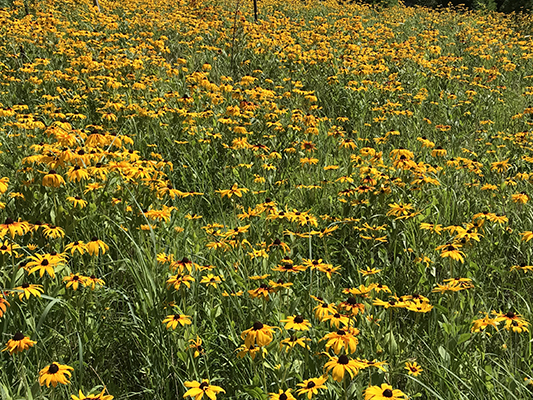
Planting trees is our number one priority.  But, equally as important are meadows. Expansive landscapes of open fields that contain a variety of plants enable the funneling of carbon into their roots and trapping it in the soil where it will be safely stashed even when the roots die.

According to the Scientific American on sustainability, “Carbon Off-Set Cowboys Let Their Grass Grow”:

“The best way to maximize the amount of carbon that gets trapped underground is to maximize grass growth.”

Screen Shot 2020-02-24 at 2.24.22 PM.png

The fact that so many different types of botanic species grow in a meadow, and their roots all intertwine underground, appears to be why meadows store more carbon than tall and bushy shrubs, although they take up a lot more land. Once carbon is trapped underground, fungi feed off it, and according to the Scientific American, fungi are often consumed by microbes and worms which stabilizes the carbon.

Screen Shot 2020-02-24 at 2.28.47 PM.png

The western half of the country, with it’s massive open terrain, has a huge opportunity to maximize this option and help the United States take giant steps forward in cutting carbon. Apparently, a cap & trade program that reward ranchers and land owners is already underway. According to Civil Eats, Indigo Ag, a Boston-based agtech company, has raised $600 million from investors to help farmers sink one trillion tons of carbon on their property. Farmers are paid $15 per metric ton of stored carbon.

It’s exciting to see that the economy that led to our stratospheric carbon emissions rate, can be used to turn the catastrophe around and inspire land owners to reach for an opportunity to reduce carbon just as quickly and significantly.🌱

© Copyright 2018 – 2021. ALL Rights Reserved.


Why is the Sunshine State so Far Behind with Solar?

Washington (GGM) Analysis | February 14, 2020
NWHillReport-Pic by Noreen Wise

One would think that with all that sunshine Florida would be way out in front on solar power, but no such luck. How can this be with such dire warning threatening the state? Some scientists believe that Miami will be the first US metropolis to become uninhabitable as a result of climate change.

Florida should be sprinting to cut carbon. When homes, towns, and businesses overproduce solar power they can either store the excess in their home batteries or send it back to the grid and get paid (net metering). Why don’t Florida residents want to take advantage of one of their most valuable assets. They can earn an income from their overabundance of this vital natural resource.

HollReport2-14-2020.png

Florida has the third largest population in the US:

  • California – 39.7million
  • Texas – 29.1
  • Florida – 21.6

HillReport2014-2020a.png

Yet, according to vivant.Solar, Florida is ranked #10 in solar power:

  • California – 21,074 MW
  • North Carolina – 4,308 MW
  • Arizona – 3,400 MW
  • Nevada – 2,595 MW
  • New Jersey – 2,595 MW
  • Massachusetts – 2,011 MW
  • Texas – 1,874 MW
  • Utah – 1,599 MW
  • Georgia – 1,566 MW
  • Florida – 1,430 MW 

It’s time to act. Florida’s carbon footprint is ranked #3 in country at 4.5 PPM. Residents have the ability to move the needle by taking advantage of natural resources. There are many state and federal incentives to assist with the transition. Let’s DO THIS!~

© Copyright 2018 – 2020. ALL Rights Reserved.
GallantLogoNWST-75