Washington (GGM) Analysis | February 18, 2021 by Pamela Scaiff; introduction and closing by Noreen Wise
Spending the past nine months in Canada during Covid, all in on sustainability immersion, taught me a lot. In fact, I’ve completely reinvented myself in such a short period of time. The most startling aspect of my metamorphosis was understanding how easy it is to live sustainably when everyone in a given community is doing so. Stronger together. My bud, Canadian sustainability guru Pamela Scaiff, is the master of sustainability and has been my supreme guide for the past four months. I’m thrilled that she agreed to share her wisdom with all of us.
Washington (GGM) Analysis | February 14, 2021 by Catherine Zacuto, M. Ed.
Wildfires are unpredictable, destructive, and, in recent times, more common. Among their many victims is the soil. Soil forms the foundation of our food chain, and so is of primary importance. Cristina Santin and Stefan H. Doerr conjure up a graphic image for us: Soil is the “living, breathing skin of the Earth.” It’s an image to keep in mind when considering how the land recovers from a fire.
Washington (GGM) Analysis | February 5, 2021 by Catherine Zacuto, M. Ed.
Saving a forest is big news these days, and just what we need to energize us. Each day, we practice sustainable living – reusing, reducing, recycling, upcycling. Every bit helps ward off climate change. So when IKEA buys a gigantic forest, saving it from development, and promises to manage it sustainably, we have reason to celebrate. We have a partner that values the science behind climate change and is willing to invest in the future. IKEA’s recent purchase of 10,680 acres of Georgia forest, and its commitment to maintain it responsibly, lend hope to all the eco-warriors out there fighting the good fight.
Washington (GGM) Analysis | January 31, 2021 by Catherine Zacuto, M. Ed.
It’s cold out there! You might be wondering about how to keep the kids busy, active, and productive. While remaining tucked away in the warm, cozy house, you can occupy them as they get ready to be Climate Superheroes! The hope of spring can inspire everyone to dig in and prepare for the near future, a future made better because you are helping fight climate change.
Washington (GGM) Analysis | January 16, 2020 by Catherine Zacuto, M. Ed.
You have set your intention for the new year: Make the world a better place. One way to do that is to plant a tree. Thomas Jefferson and John Adams made similar plans as they wandered the gardens of England in 1786. Jefferson and Adams, sometimes adversaries with opposing political views, joined together to investigate the worthiest of English gardens as they waited for trade negotiations to move forward in Europe. Appreciatively scouring the estates, these two Founding Fathers admired the winding paths and natural features of the most modern gardens.
Washington (GGM) Analysis |December 19, 2020 by Catherine Zacuto, M. Ed.
Wandering through a wooded park or along a shady path, it’s easy to miss what’s right before our eyes. How often do we consider the gifts before us, planted long ago? The cool breeze and fresh fragrance are momentary experiences that began with the planting of seeds. No matter how the trees, shrubs, and understory got there, whether through nature or a particular person, you and I are the beneficiaries.
Washington (GGM) Analysis | December 18, 2020 by Noreen Wise
The planet will keep revolving around the sun, no matter how destructive and irresponsible humans are. But we humans won’t. Humans are mammals. Mammals rely on our habitat to survive. And mammals eventually become extinct when our habitat disappears. Eighty mammals have gone extinct in the past five centuries.
Washington (GGM) Analysis | November 4, 2020 by Michael Wells, Attorney @slnc01
Former Vice President Joe Biden and President Donald Trump are locked in a tight battle for the presidency, which may come down to Pennsylvania. Big coal and facking employ many people in Pennsylvania, and, understandably, fracking is a huge issue. All the votes have been cast and are being counted, but the Pennsylvania race (and possibly the presidency) may come down to the issue of fracking. The two candidates’ positions are more similar than you may think.
Hydraulic fracturing (fracking) is a technique for extracting oil and natural gas by firing pressurized liquid into the Earth’s crust. Trump has long supported the practice and has even signed an Executive Order to protect fracking. Biden’s position has been to say he will not ban fracking, but that he will look towards alternative fuel sources, perhaps in an effort to win key states such as Pennsylvania, Michigan, and Ohio (which he appears to have lost). One indication of how important this issue is in Pennsylvania can be gleaned from Vice Presidential Kamala Harris’s October 6, 2020 tweet:
While Biden and Harris must appeal to the Green New Deal part of the Democratic Party, they must also win key states such as Pennsylvania, which rely heavily on fracking. To what extent this is just politics, remains to be seen, but, given what appears to be a Repulican Senate, legislation to ban or limit fracking does not appear possible. This means this dangerous practice will continue.
According to an article from Euronews, fracking poses a number of environmental hazards:
Methane leaks occur frequently to the tune of one million tons in Pennsylvania per year. The industry only reported 64,000 tons.
Methane and other gasses released through fracking are a problem because they trap twenty-five more times heat in the atmosphere than carbon dioxide.
Fracking pollutes the groundwater supply, which can cause cancer.
From a legal standpoint, the pollution issues pose millions in liability for companies that are not careful. Quite frankly, even if these companies are careful, the risk is quite high. Although not the result of fracking, Flynt, Michigan is a cautionary tale as to what happens when drinking water is contaminated.
Fracking does supply jobs, upwards of ten million nationally, but, if Biden wins, his energy plan will likely aim to rejoin the Paris Agreement. It is unclear whether fracking as it stands in the United States would violate or otherwise cause problems with the agreement.
Biden has said he opposes fracking on public lands, but it is unclear what exactly this means. Even if Biden were to oppose fracking altogether, it is unlikely he could get a bill limiting or banning it to pass the Senate due to the Republican majority.
Fracking’s future remains uncertain in the United States, but it does appear it is not going anywhere anytime soon even after the votes are counted and a victor declared.
Washington (GGM) Analysis | October 30, 2020 by Noreen Wise
Do bushes sequester carbon too? Is planting more shrubs as important as planting more trees in helping to lower atmospheric carbon levels and reverse global warming?
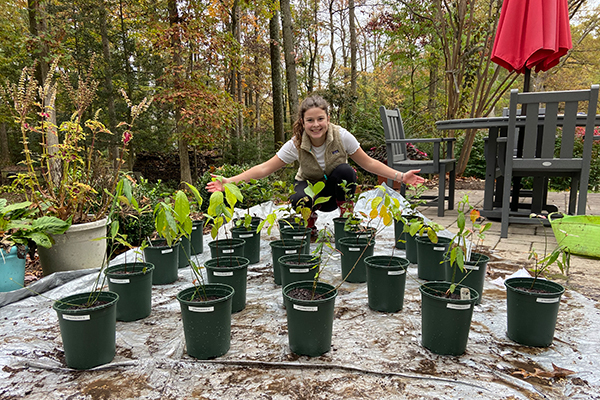
One student at W. T. Woodson High School in Fairfax, Virginia is determined to find out. Ninth grader Julia Victor has accepted the challenge to conduct her own science experiment for the upcoming Regeneron International Science and Engineering Fair and is busy mapping out the procedure she will follow to test how much carbon five species of Northern Virginia natives can absorb in comparison to one another.
The Regeneron ISEF has a wide range of categories, 21 in all, that 1800 participating students are selecting from. As a nature lover, Earth and Environmental Sciences was Julia’s top choice, which she quickly narrowed down to climate change. Julia asked herself questions about which NoVa natives might absorb the most carbon. She then spent time researching, and eventually arrived at her hypothesis: “I am hypothesizing that the holly tree will grow to be the largest and will absorb the most carbon. I also think that shrubs might not be far behind. I am hoping to be able to come to the conclusion that shrubs and smaller plants are just as important to reversing climate change as large trees.”
Julia will be implementing the following steps to test her hypothesis. All the plants will be kept in open containers.
Remove the soil and weigh each plant. Record each plant’s bare root weight (without soil).
If plants are not the same weight, trim each plant until they are approximately equal.
Plant each plant in its new container with 1 gallon of soil each. Label each container with the plant species.
Water each plant with 1 cup of water each.
Set up each plant’s light to a 12-hour timer to simulate the sun.
Water each plant regularly with its recommended amount of water.
After 25 days, remove all the soil from the bare roots from each plant and weigh.
An important science experiment like this one is challenging enough without there being an extra layer of difficulty. But, Julia isn’t daunted by the complications during the fall season. Julia explained, that there are far less species available for her to choose from this late in the year. Many NoVa natives are nearly dormant, so there’s far less photosynthesis, which means very little, if any, carbon absorption. But Julia persevered and unearthed several standouts she can rely on:
American Holly
Strawberry bush
Spicebush
Arrowwood Viburnum
Black Chokeberry
We’ll be checking back with Julia in December to learn about the conclusions she drew once she completes her experiment, weighs each plant, and is able to identify the winning species that sequestered the most carbon. Julia will be managing a total of 25 small plants for her project.
This is a lot of extra work during a very challenging global pandemic. Julia began her freshman year with virtual learning, and appears to be very excited about having something she feels passionately about, nature and science, to keep her mind preoccupied in the midst of a health crisis. “This is my first time participating in the Regeneron ISEF and I’m excited to see everyone’s projects, especially during covid-19.”
I asked Julia how she keeps from feeling intimidated by such a challenging, high level competition. Her response was one that we could all apply to our own lives.
“These days, it’s very easy to get intimidated by projects and big assignments. I found that if I don’t think about it as an assignment, but rather as something I enjoy, then it becomes much easier to do get motivated by my curiosity.”
—
Nature is an exciting and therapeutic ally to help combat our daily challenges during covid. A major destresser, thanks to its beauty and healing scents, as well as the chemicals it emits that we humans respond to by releasing our own positive chemicals—serotonin for example. Nature is very responsive to human interaction, both positively and negatively. Humans and nature are connected through a symbiotic relationship. What we give is what we get. We see this with climate change of course, but it’s equally as powerful on the positive side of the coin. Nature nurtures. It comforts. Heals. Inspires. Supports. Motivates. Hanging out with nature makes us physically and emotionally stronger. It’s time to recognize this fact and act on it. Planting millions of trees and shrubs and flowers and all types of nature is an investment that pays us back exponentially. So, let’s get planting! If it’s too cold where you are right now, you can plant a seedling indoors in a container and leave inside until spring.
Washington (GGM) Analysis | October 4, 2020 by Noreen Wise
There’s never been a more important time to plant trees than right now. After massive wildfires scorched millions of acres of forests across the western United States, to the ongoing need to cut atmospheric carbon levels in order to reduce global warming, trees are now more important than ever for sustaining human life on our planet. The only way our children will have mature trees tomorrow, is if we plant seedlings today.
At the World Economic Forum in Davos Switzerland in January 2020, hundreds of nations across the globe committed to planting a trillion trees by 2050. According to the Food and Agriculture Organization’s 2016 ranking, the United States is 33.93 percent forested area. Sadly, prior to Davos, the United States was hovering well below its potential for tree planting despite how much room we have to plant trees. Canada on the other hand, has been a top performer, planting 500 million trees in 2019. During this same year, the US National Forest Foundation planted 5 million trees, nearly double their 2018 total, which is aggressive, but a long way off Canada’s 500 million. There doesn’t appear to be a national data base keeping track of US totals that incorporates tree planting in local communities on private property, so the total number of trees planted in US for any given year is difficult to calculate. But what we do know, is that the US chopped down 36 million trees in 2019, and in 2020, in addition to the millions of leveled trees we ax on an annual basis, we lost 30 billion mature trees in the West Coast wildfires, which is staggering.
Ethiopia is a 2020 tree planting champion, succeeding at putting 350 million trees in the ground in 12 hours this past July 2020. The US needs to rush to catch up. In most states, trees can only be planted a few months out of the year. There’s a window in both the spring and the fall. Thus, it’s vitally important that we take advantage of each and every opportunity. Homeowners have to be the drivers of our national tree planting efforts if we’re going to succeed.
Planting a tree to remember someone whose life was cut short — whether that be from covid, gun violence, wildfires and other natural disasters, a car accident, cancer, and multiple other tragedies — or is still alive but but going through a very difficult time, is a great way of showing empathy and letting others know a loved one is being thought of regularly. It also motivates us into action. This wonderful way of keeping spirits alive and communities full of hope, helps families and communities heal, while at the same time saving the planet.
Gallant Gold Media is distributing 300 FREE redbud and button bush seedlings on Saturday, October 24, 2020, from 12 noon – 3 PM at GMU, courtesy of Fairfax ReLeaf. Residents in Fairfax County and Northern Virginia can register to pick up a free seedling at GMU so that homeowners and businesses throughout the area can plant trees and bushes this fall to remember all those in our community who’ve been lost to covid. Click here to register. This is first come first serve, so please register ASAP.
If your business has any clients or employees who have loved ones to covid, a redbud seedling is a wonderful gift to let them know you care and empathize with what they’re going through. Redbud’s are a top choice to feature in the front yard landscape, with beautiful pink spring blossoms and very easy to care for while they grow.
Again, limited quantity, with some HOAs ordering large bundles, and first come first serve, so please register ASAP.











 Climate Action Report